🇭🇺 Budapest
Eastern Europe
- Akácfa söröző
- Belgian Brasserie Henri
- Bordizsár
- Budapest Terrace
- Cafe Room
- Café Vian kávéház
- Captain Cook
Metro + Bus line 200E Bus line 200E runs between Terminal 2 and Kőbánya-Kispest Metro station, taking 25 min, bus fare Ft500. You there buy a Metro ticket for another Ft500 and ride line 3 to the city centre, about 20 mins to the main interchange at Deák Ferenc tér. The bus runs all day every day, with 7-8 minutes frequency during the day, 30-60 minutes at late night.
With majestic architecture and a historic thermal bath network, Budapest remains one of the most accessible and scenic capitals. Recent urban reforms aim to strengthen public transport and the safety of central districts.
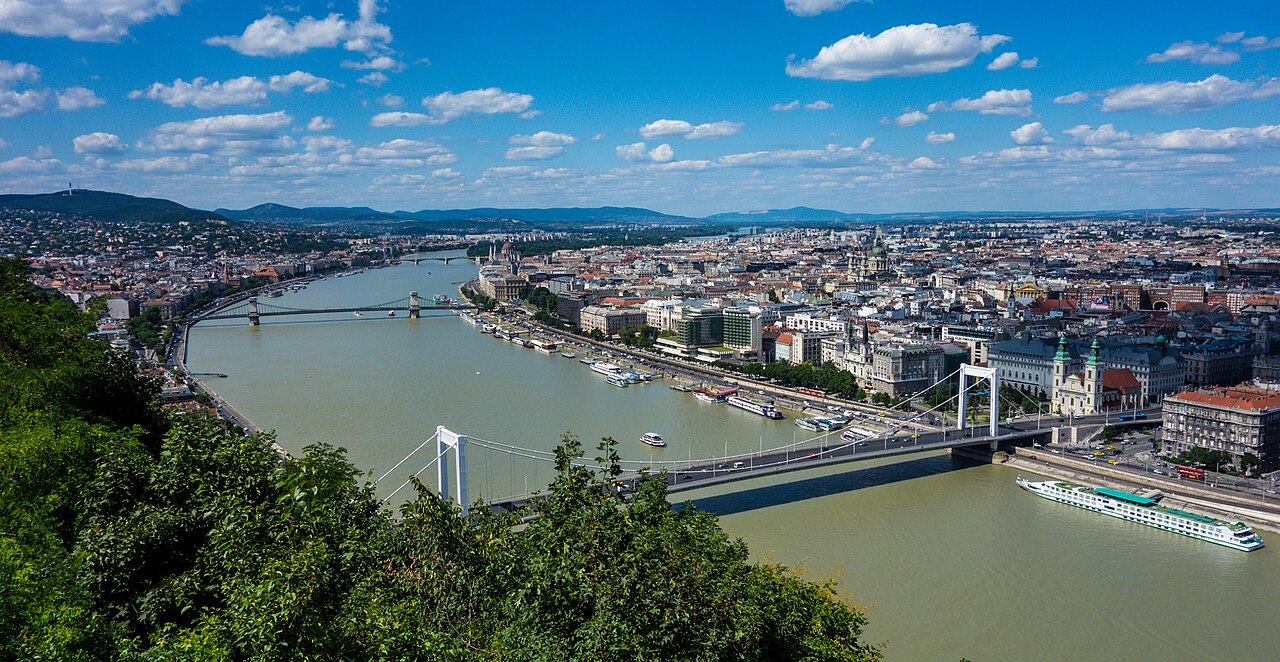
Budapest is the capital city of Hungary. With a unique, youthful atmosphere, world-class classical music scene, a pulsating nightlife increasingly appreciated among European youth, and last but not least, an exceptional offer of natural thermal baths, Budapest is one of Europe's most delightful and enjoyable cities. Due to the exceedingly scenic setting, and its architecture it is nicknamed "Paris of the East". The modern-day Budapest results from the amalgamation of two historic cities lying right opposite each other over the Danube river. Buda is the western (right) bank side, with the high hill atop which the Buda castle sits. Pest is the relatively flat eastern (left) bank side, with the Parliament, numerous other stately buildings, and busy streets retaining all their 19th century architectural heritage. In 1987 Budapest was added to the for the cultural and architectural significance of the Banks of the Danube, the Buda Castle Quarter and Andrássy Avenue. Although Budapest is administratively divided into 23 numbered districts (always written in Roman numerals) it is colloquially often divided into parts, roughly corresponding to the two major cities of Buda and Pest, which it comprises. Listings of particular points of interests - museums, historic monuments, restaurants, bars, hotels, shopping opportunities and such - can be found in the following articles: Of course, quarters often offer their own atmosphere due to their history and inhabitants. Roughly speaking, areas near to, especially inside of Nagykörút (Great Boulevard or Ringroad, served by Tram 4 and Tram 6) are considered central, even if some of these are in less than perfect condition and not typically frequented by tourists. In Pest, Kiskörút (Small Boulevard) is traditionally considered as the border of the centre proper, including some highly touristed areas. Informally, quarters are known under their own historical name which are often referred to by the locals. The names are often linked to members of the House of Hapsburg or - in fringe areas - the names of villages or towns which later became part of Budapest. Particularly interesting quarters are Belváros (Inner City) and Lipótváros (Leopold Town), together form the Belváros district (a bit confusing but usually the biggest or oldest quarter gave its name to the entire district), the heart of Pest, including a number of major sights but also beautiful squares and cafés. With the Parliament, a number of ministries and banking houses, Lipótváros is also a major political and business centre of the country. The name refers to the Hapsburg Emperor Leopold I whose coronation to the King of Hungary in 1790 gave rise to the name of the then-new quarter. Újlipótváros (New Leopold Town) The inner part of the XIII.
Structured data source (DTD-validated XML — city_report.dtd):
Canonical URI (element <source_url>, also used as itemid microdata):