What UNESCO says
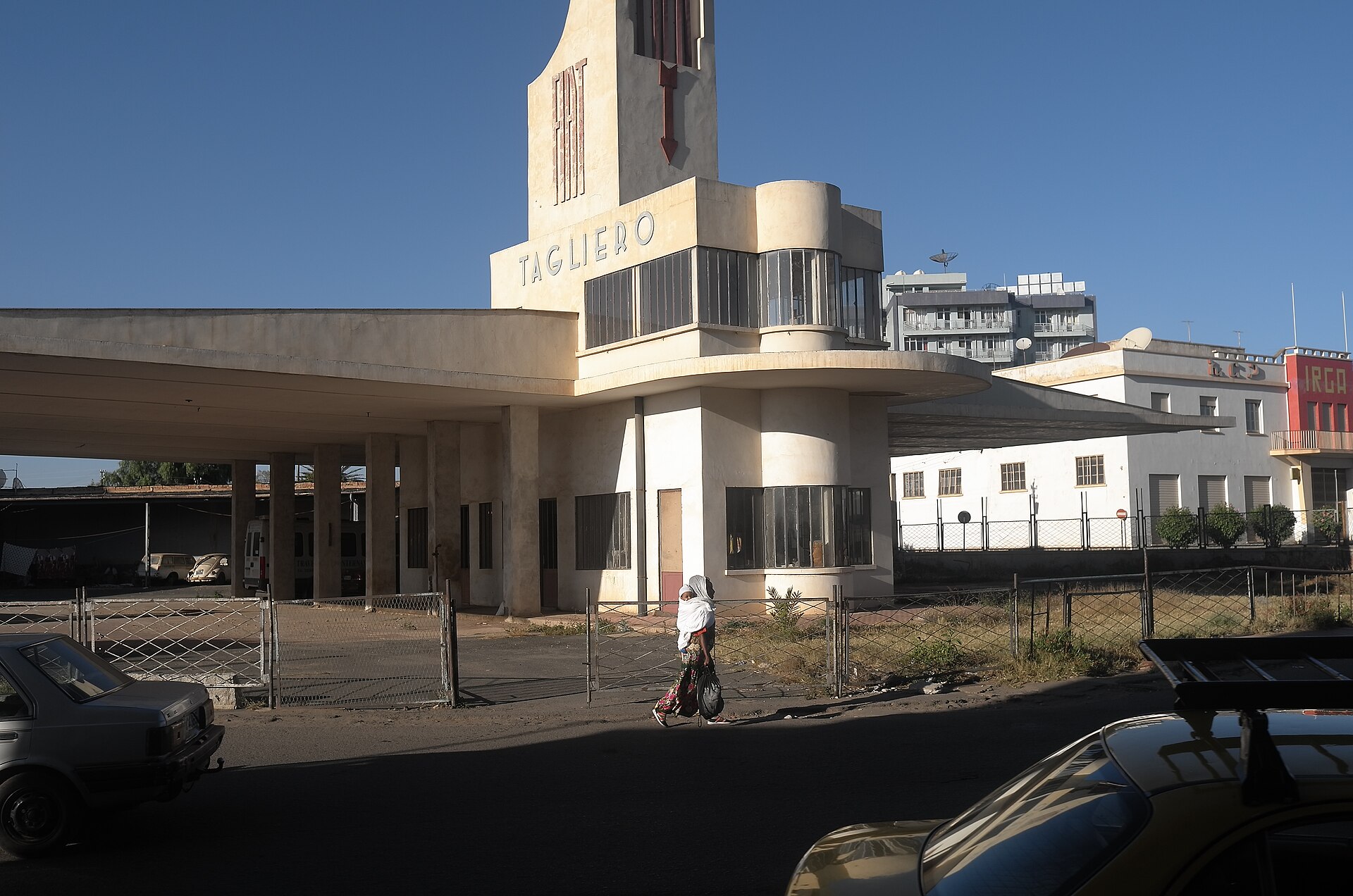
UNESCO describes the property in these words: “Located at over 2,000 m above sea level, the capital of Eritrea developed from the 1890s onwards as a military outpost for the Italian colonial power. After 1935, Asmara underwent a large scale programme of construction applying the Italian rationalist idiom of the time to governmental edifices, residential and commercial buildings, churches, mosques, synagogues, cinemas, hotels, etc. The property encompasses the area of the city that resulted from various phases of planning between 1893 and 1941, as well as the indigenous unplanned neighbourhoods of Arbate Asmera and Abbashawel. It is an exceptional example of early modernist urbanism at the beginning of the 20th century and its application in an African context.”[1]
Background
Asmara is the capital and largest city of Eritrea. It stands at 2,325 metres, which Wikipedia says makes it the sixth-highest capital in the world and the second-highest in Africa.[2] Local tradition says the city was founded when four villages united to live in peace after long conflict, and the article describes it as a settlement of over half a millennium on the trade route to Massawa.[2] It rose to prominence in the 20th century as capital of Italian Eritrea, when rapid urbanisation earned it the name Piccola Roma, 'Little Rome'. UNESCO declared it a World Heritage Site in 2017 for its well-preserved Italian colonial modernist architecture.[2]
Architecture and the listing, as reported in 2017
Smithsonian Magazine wrote in 2017 that Asmara is rich in modernist architecture built while the Italians colonised Eritrea, when Italian architects could try bold ideas away from Europe's conservative cultural norms.[3]
It names the Fiat Tagliero service station, completed in 1939 and shaped like an airplane, an Art Deco bowling alley, and a building designed in the shape of an old radio set. The city has been nicknamed Africa's Miami for its Art Deco buildings.[3]
The report adds that Eritrean officials lobbied hard for the World Heritage listing, that no foreign press were invited to the celebrations, and that fewer than 1,000 tourists visited in 2015.[3]
- Eritrean historians and architects on the city, beyond the Tigrinya oral tradition summarised by Wikipedia.
- How the buildings are used and cared for today.
- Local voices: none yet.
- The 2017 report is a short news item written from outside Eritrea: Eritrean architects' and residents' views of the listing are not covered here, and the listing's political context is as that article describes it.
Sources
- Institutional[1] Asmara: A Modernist African City. UNESCO World Heritage Centre, World Heritage List (open data, CC BY-SA 4.0). whc.unesco.org retrieved 7 Oct 2026
Read from UNESCO's open-data record (data.unesco.org, dataset whc001); the web page itself could not be opened from this project's tools. Texts are UNESCO's own. - Encyclopedia · to verify[2] Asmara. Wikipedia. en.wikipedia.org retrieved 7 Oct 2026
Used for background that the UNESCO record does not give. Each statement is limited to the article's lead and opening sections; confirm against specialist sources. - Press[3] Brigit Katz, Asmara, the Capital of Eritrea, Named World Heritage Site. Smithsonian Magazine, 12 Jul 2017. www.smithsonianmag.com retrieved 7 Oct 2026
A short news item written from outside Eritrea.