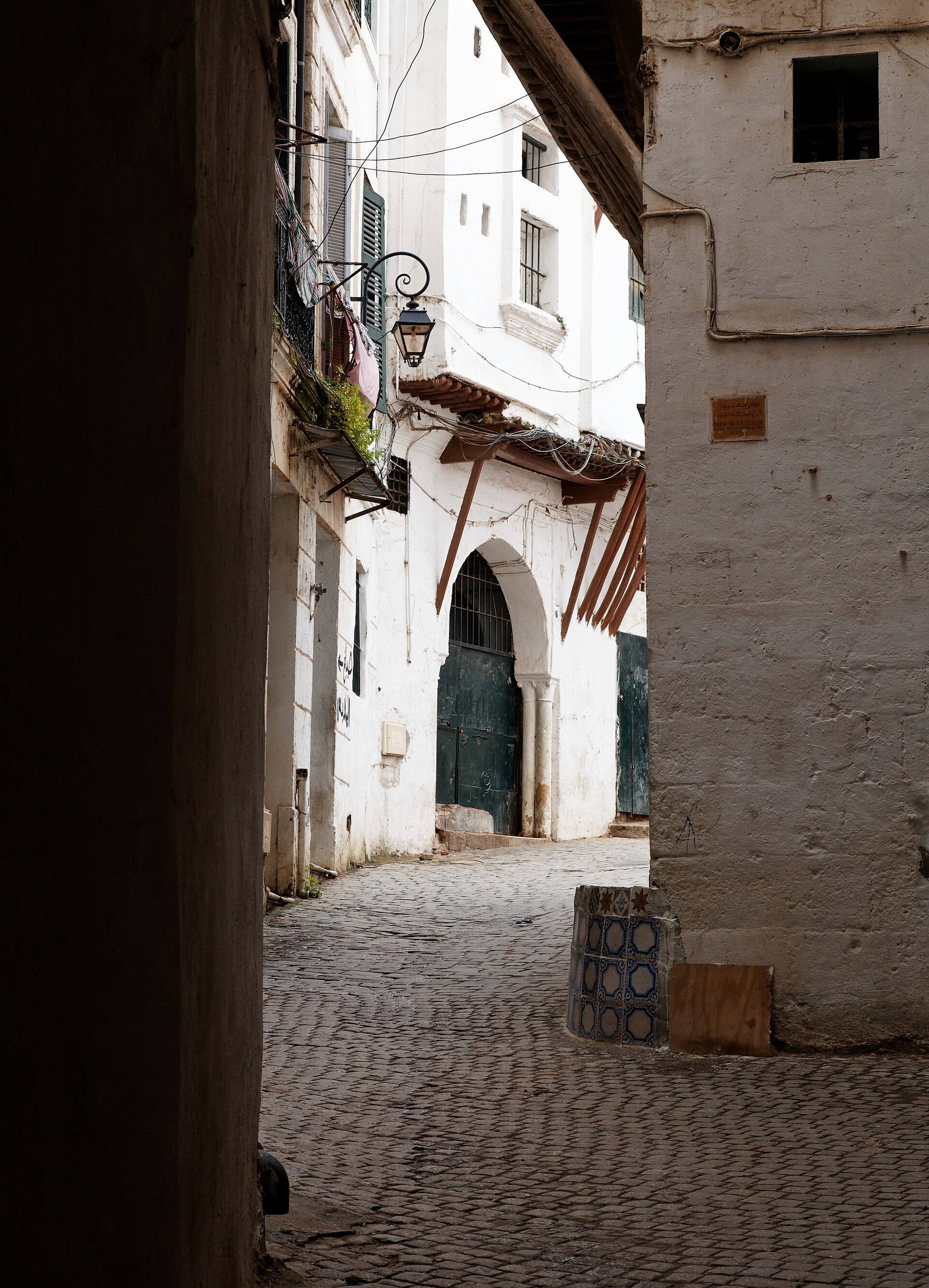
What UNESCO says
UNESCO describes the property in these words: “The Kasbah is a unique kind of medina, or Islamic city. It stands in one of the finest coastal sites on the Mediterranean, overlooking the islands where a Carthaginian trading-post was established in the 4th century BC. There are the remains of the citadel, old mosques and Ottoman-style palaces as well as the remains of a traditional urban structure associated with a deep-rooted sense of community.”[1]
Background
The Casbah is the old town of Algiers. Wikipedia says it was founded in 944 by the Zirids and has been a World Heritage Site since 1992.[2] The article says the place was probably inhabited from the Neolithic, was first a Phoenician port, and then Berber and Roman, and that the 10th-century Zirid plan is the present urban framework.[2] It reached its peak under the Regency of Algiers, when it was the seat of power. The French colonised it in 1830 and it was gradually marginalised, and during the Algerian War it was a stronghold of FLN fighters.[2]
Restoring the Casbah, as reported in 2022
France 24 reported in July 2022 that the Casbah, a densely populated UNESCO-listed district about a kilometre across, has some buildings weakened by earthquakes, floods and fires that are still propped up with scaffolding. More than 300 buildings were shored up in 2008 and 2013.[3]
A restoration plan launched in 2012 has a budget of 170 million euros. Part of the citadel, with the Dey's palace, mosque and ammunition store, has been partly open to visitors since November 2020, and the Ketchaoua mosque, closed since 2008, reopened in April 2018 after 37 months of work funded entirely by the Turkish government.[3]
Seven restoration projects were under way. The report says residents are sometimes a difficulty, because access for architects and work crews can be refused, and that a cluster of four houses serves as a refuge for independence figures including Djamila Bouhired.[3]
- Algerian historians on the Regency and on the Battle of Algiers.
- Local voices: none yet.
- Residents' own account of living in the Casbah and of the restoration: the 2022 report mentions them only as an obstacle, which is one side of the story.
Sources
- Institutional[1] Kasbah of Algiers. UNESCO World Heritage Centre, World Heritage List (open data, CC BY-SA 4.0). whc.unesco.org retrieved 7 Oct 2026
Read from UNESCO's open-data record (data.unesco.org, dataset whc001); the web page itself could not be opened from this project's tools. Texts are UNESCO's own. - Encyclopedia · to verify[2] Casbah of Algiers. Wikipedia. en.wikipedia.org retrieved 7 Oct 2026
Used for background that the UNESCO record does not give. Each statement is limited to the article's lead and opening sections; confirm against specialist sources. - Press[3] Renovate the Casbah: Efforts speed up to restore historic Algiers district. France 24, 10 Jul 2022. www.france24.com retrieved 7 Oct 2026
A news report from July 2022; the restoration has moved on since.