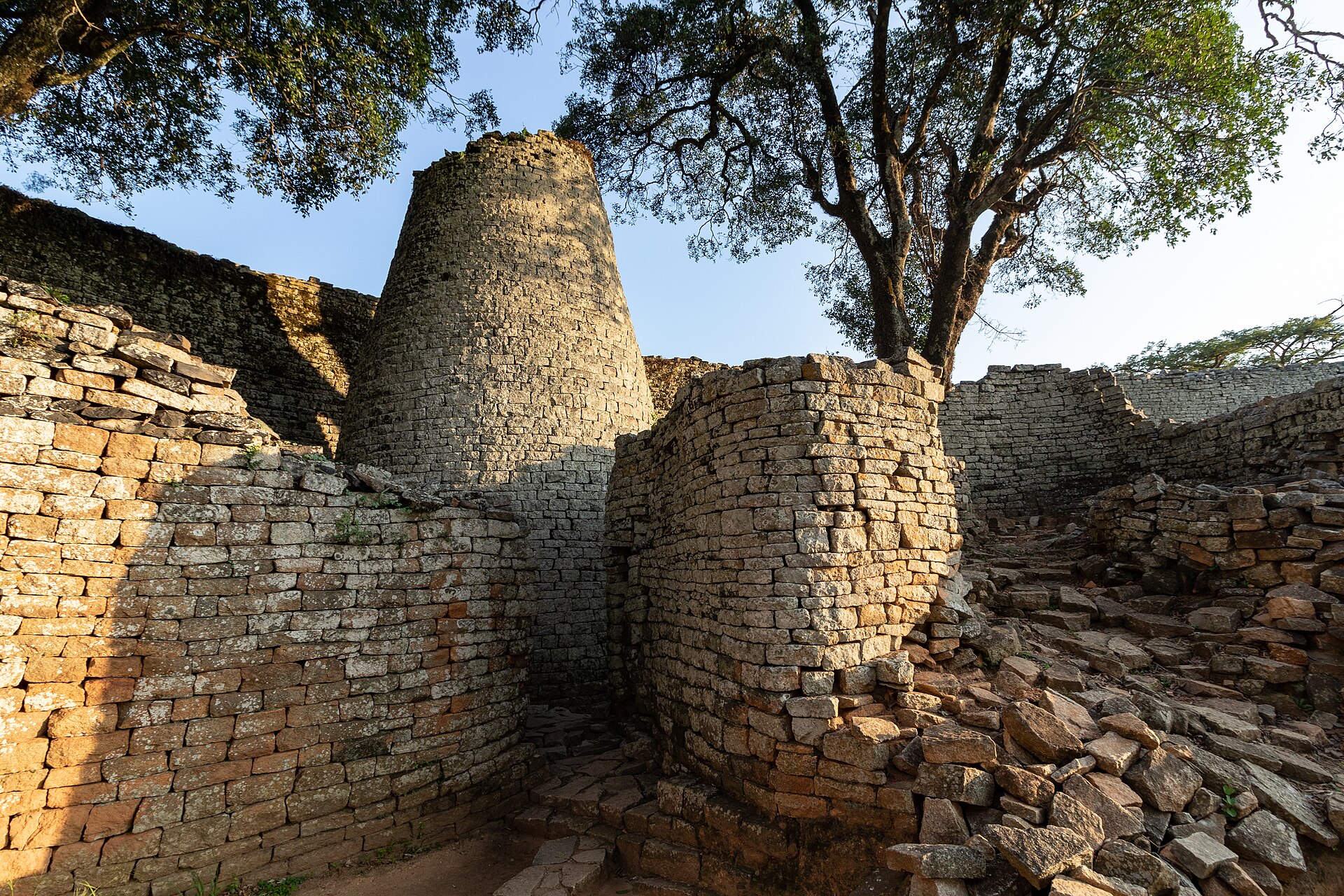
What UNESCO says
UNESCO describes the property in these words: “The ruins of Great Zimbabwe – the capital of the Queen of Sheba, according to an age-old legend – are a unique testimony to the Bantu civilization of the Shona between the 11th and 15th centuries. The city, which covers an area of nearly 80 ha, was an important trading centre and was renowned from the Middle Ages onwards.”[1]
Background
Wikipedia describes Great Zimbabwe as a city in the hills near Masvingo, settled from around 1000 AD and the capital of the Kingdom of Great Zimbabwe from the 13th century. It is the largest stone structure in precolonial southern Africa.[2] Major construction ran from the 11th to the 15th century, the city was abandoned in the 16th or 17th, and the article says it was built by ancestors of the Shona people.[2] The stone city covers 7.22 square kilometres. The article notes that population estimates vary: earlier ones suggest a peak of around 20,000, while a recent study suggests it did not exceed 10,000.[2] The site has a Hill Complex, a Valley Complex and the Great Enclosure, built at different times.[2]
Who built it, and the argument about it
A 1998 article by the archaeologist Roderick McIntosh says Great Zimbabwe was built between the twelfth and fifteenth centuries by the ancestors of the Shona, and that it is one of some 300 known stone enclosure sites on the Zimbabwe Plateau.[3] It dates the Hill Complex to around AD 1250, the Great Enclosure to the early fourteenth century and the Valley Complex to the early fifteenth.[3] It says the city may have housed as many as 18,000 people at its peak in the late fourteenth century. Wikipedia mentions a more recent study that puts the population at no more than 10,000, so estimates have fallen since.[3][2]
Public television's NOVA site says the site shows iron use by the third century AD, with its rise and its finest walls in the fourteenth and fifteenth centuries, during a great increase in trade.[4] Early European visitors attributed the ruins to Egyptians, Phoenicians or other outsiders, McIntosh writes. David Randall-MacIver concluded in 1905 that they were 'unquestionably African in every detail' and medieval, and Gertrude Caton-Thompson confirmed this in 1931.[3][4] NOVA says racial prejudice surrounded the monument until quite recently, and that in the 1960s and 70s Rhodesia's white government suppressed findings that attributed it to African builders, forcing out the prehistorian Garlake.[4] It adds that several African groups claim a link to the site and that the Lemba are particularly insistent about their ancestors' part.[4]
- Zimbabwean historians' own accounts and how the site is used in national identity today. The sources found here are British and American.
- A scholarly study of the dating and the population estimates, to settle the difference between 18,000 and 10,000.
- The Shona and Lemba claims, in their own voices.
- Local voices: none yet.
Sources
- Institutional[1] Great Zimbabwe National Monument. UNESCO World Heritage Centre, World Heritage List (open data, CC BY-SA 4.0). whc.unesco.org retrieved 7 Oct 2026
Read from UNESCO's open-data record (data.unesco.org, dataset whc001); the web page itself could not be opened from this project's tools. Texts are UNESCO's own. - Encyclopedia · to verify[2] Great Zimbabwe. Wikipedia. en.wikipedia.org retrieved 7 Oct 2026
Used for background that the UNESCO record does not give. Each statement is limited to the article's lead and opening sections; confirm against specialist sources. - Academic · to verify[3] Riddle of Great Zimbabwe. Archaeology magazine 51(4), by Roderick J. McIntosh (July/August 1998). archive.archaeology.org retrieved 7 Oct 2026
An archaeologist writing in a general-audience magazine; this is the abstract page. Estimates of population and dates have moved since 1998. - Press · to verify[4] Great Zimbabwe (NOVA online, 'Lost Tribes of Israel' companion pages). PBS NOVA. www.pbs.org retrieved 7 Oct 2026
Public-television companion page. It names Randall-MacIver, Caton-Thompson and the prehistorian Garlake. Read through a page summary; confirm quotations against the original works.