What UNESCO says
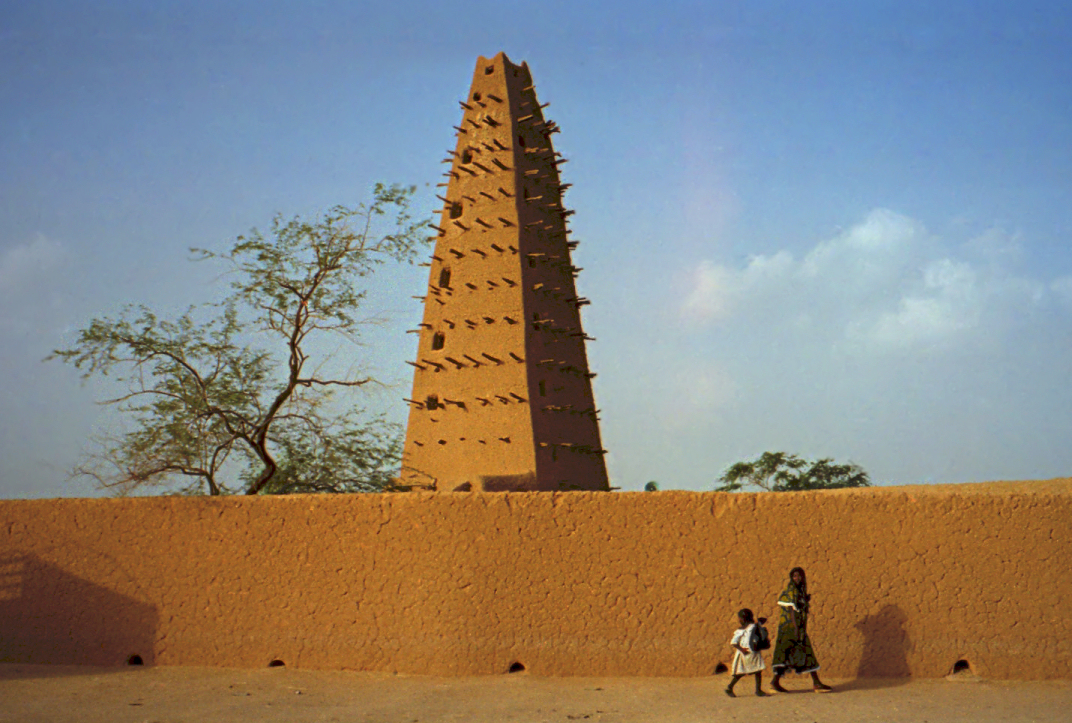
UNESCO describes the property in these words: “Known as the gateway to the desert, Agadez, on the southern edge of the Sahara desert, developed in the 15th and 16th centuries when the Sultanate of Aïr was established and Touareg tribes were sedentarized in the city, respecting the boundaries of old encampments, which gave rise to a street pattern still in place today. The historic centre of the city, an important crossroads of the caravan trade, is divided into 11 quarters with irregular shapes. They contain numerous earthen dwellings and a well-preserved group of palatial and religious buildings including a 27m high minaret made entirely of mud brick, the highest such structure in the world. The site is marked by ancestral cultural, commercial and handicraft traditions still practiced today and presents exceptional and sophisticated examples of earthen architecture.”[1]
Background
Agadez, once spelled Agadès, is the fifth largest city in Niger, with 110,497 people at the 2012 census. It lies in the Sahara and is the capital of the Sultanate of Agadez, one of the traditional Tuareg federations.[2] The article says it was founded before the 14th century and grew around the trans-Saharan trade, becoming the most important city of the Tuareg. Caravans still bring salt from Bilma.[2] It became a sultanate in 1449, was conquered by the Songhai Empire in 1515 and stayed part of it until 1591. By then it had around 30,000 people and was a key stop for caravans between Kano and Timbuktu.[2]
A city that has had to change, as reported in 2025
Al Jazeera described in July 2025 the Grand Mosque, built of wooden beams and mudbricks, as the world's tallest mudbrick building, which served travellers as both watchtower and compass. Tuareg artisans learned the building techniques as far away as Timbuktu.[3]
The gridded streets of the old town reflect how early Tuareg settlers organised in encampments based on sub-tribes. Between the 8th and 16th centuries, camel caravans carrying ceramics, silk from Arabia and West African gold stopped there, and the old town was listed by UNESCO in 2013.[3]
After 2011 the population doubled to 300,000 as migrants sought passage north, the article says. Tourism has collapsed after a Tuareg rebellion and, more recently, the July 2023 coup, and a trader aged 63 says life is hard for anyone who works in tourism.[3]
- The recent period: security, migration routes through the city and the state of the old town. The part of the article read here stops before them.
- The sultanate and its role today, from Tuareg voices.
- Local voices: none yet.
- Residents' and Tuareg artisans' own accounts of the old town and its mosque: the 2025 article quotes only one trader. The figures for the population and the migrant trade are the article's, not checked against a census.
Sources
- Institutional[1] Historic Centre of Agadez. UNESCO World Heritage Centre, World Heritage List (open data, CC BY-SA 4.0). whc.unesco.org retrieved 7 Oct 2026
Read from UNESCO's open-data record (data.unesco.org, dataset whc001); the web page itself could not be opened from this project's tools. Texts are UNESCO's own. - Encyclopedia · to verify[2] Agadez. Wikipedia. en.wikipedia.org retrieved 7 Oct 2026
Used for background that the UNESCO record does not give. Each statement is limited to the article's lead and opening sections; confirm against specialist sources. - Press[3] Shola Lawal and Hannane Ferdjani, Agadez: the ancient Sahelian city forced to change amid trying times. Al Jazeera, 29 Jul 2025. www.aljazeera.com retrieved 7 Oct 2026