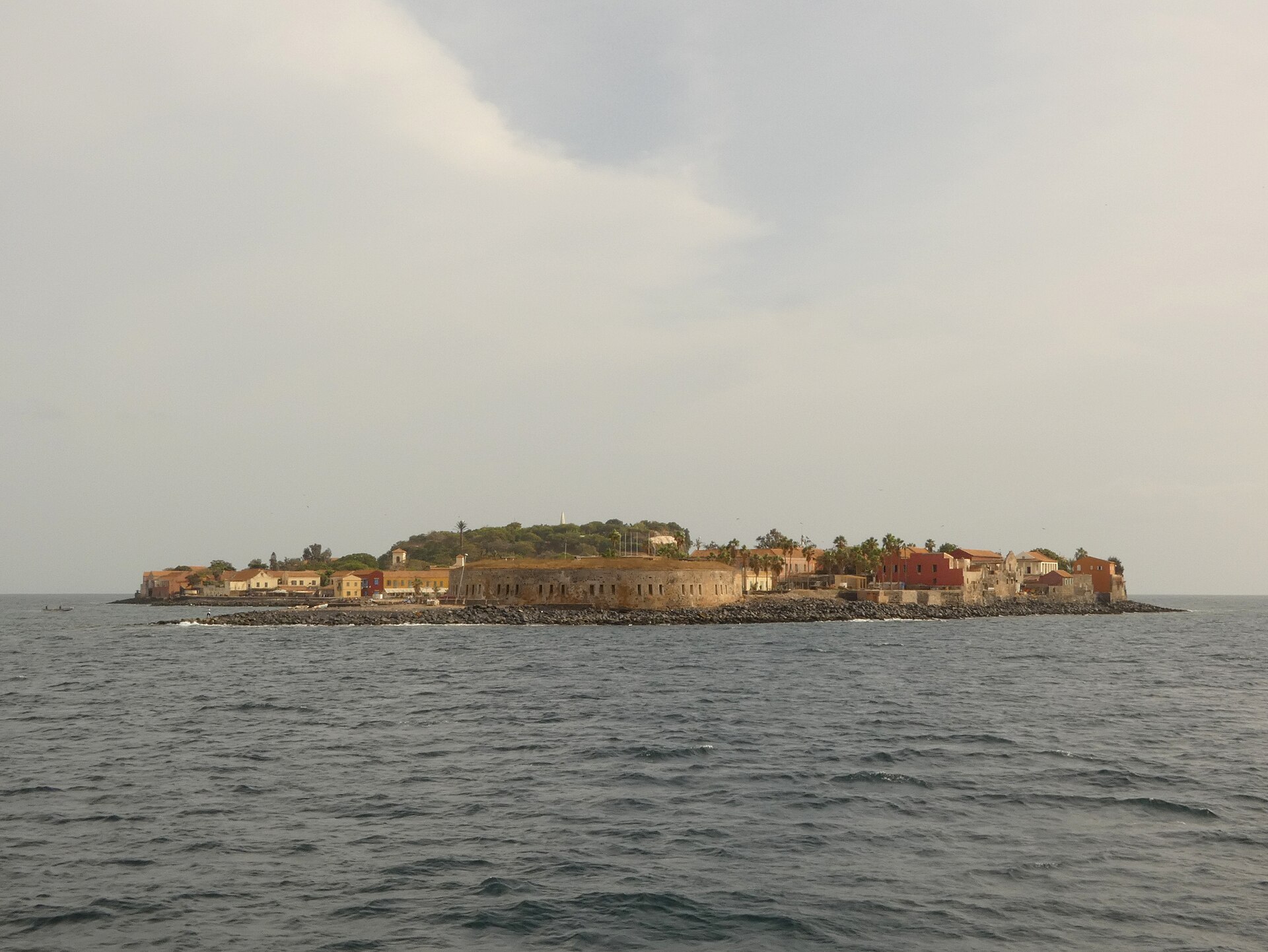
What UNESCO says
UNESCO describes the property in these words: “The island of Gorée lies off the coast of Senegal, opposite Dakar. From the 15th to the 19th century, it was the largest slave-trading centre on the African coast. Ruled in succession by the Portuguese, Dutch, English and French, its architecture is characterized by the contrast between the grim slave-quarters and the elegant houses of the slave traders. Today it continues to serve as a reminder of human exploitation and as a sanctuary for reconciliation.”[1]
What it is
Gorée is a small island about 900 metres long and 350 metres wide, two kilometres out to sea from the harbour of Dakar.[2] It is the smallest and least populated of Dakar's 19 districts, with 1,680 residents at the 2013 census.[2]
- Inscribed
- 1978[1]
- Category
- Cultural[1]
- Distance from Dakar
- about 2 km by sea[2]
- Area
- 18.2 hectares[2]
- Residents
- 1,680 (2013 census)[2]
- House of Slaves built
- around 1776[3]
The best-known building is the House of Slaves, built around 1776 by Nicolas Pépin, brother of the signare Anne Pépin. It became a museum in 1962 under the curator Boubacar Joseph Ndiaye.[3] It is visited by roughly 200,000 people a year, according to the same article, and Nelson Mandela, Pope John Paul II and Barack Obama are among the visitors it lists.[3]
Timeline
- 1444The Portuguese establish a presence on the island.[2]
- 1628The Dutch arrive and build forts.[2]
- 1663–1664A brief period of English control.[2]
- 1677France captures the island.[2]
- 1758–1763 and 1779–1783Two periods of British occupation, during and after wars with France.[2]
- 1960Senegal becomes independent.[2]
A contested memory
Historians disagree about how many people were held or shipped from Gorée, and about what the House of Slaves can show.[2][3] Ndiaye, the museum's first curator, claimed that more than a million enslaved people passed through the house. Supporters later argued for as many as 15 million.[3] The historian Philip D. Curtin's research, as the Wikipedia article reports it, records 180,000 enslaved Africans transported from the French posts in Senegambia between 1711 and 1810.[3] A 2004 press article quotes Curtin estimating that about 50,000 people may have spent time on the island over four centuries, and saying that it was never a key departure point.[4] Wikipedia's article on the island gives a figure of no more than 500 people a year.[2]
The same press article reports that the House of Slaves was built in 1775–1778 as a merchant's home, and quotes Curtin saying that the rocks around the Door of No Return are too many for boats to dock there.[4] It also quotes the museum curator Abdoulaye Camara as saying the house gives "a distorted account" meant for tourists.[4] The historian Ana Lucia Araujo is quoted in Wikipedia's article as saying it is "not a real place from where real people left in the numbers they say".[3]
- A scholarly history of Senegambia, to replace Wikipedia and the press article for the numbers. Curtin (1969) is named but has not been read here.
- Senegalese historians' position and the view of the museum today, beyond one curator quoted in a 2004 article.
- Another figure appears in the House of Slaves article, 26,000 people recorded as passing through the island, without a clear source in what was read.
- UNESCO's longer statement of why the island was inscribed (the open-data record has a justification text that has not been used here).
- Local voices: none yet.
Sources
- Institutional[1] Island of Gorée. UNESCO World Heritage Centre, World Heritage List (open data, CC BY-SA 4.0). whc.unesco.org retrieved 7 Oct 2026
Read from UNESCO's open-data record (data.unesco.org, dataset whc001); the web page itself could not be opened from this project's tools. Texts are UNESCO's own. - Encyclopedia · to verify[2] Gorée. Wikipedia. en.wikipedia.org retrieved 7 Oct 2026
Used for the island's size, population, the sequence of colonial powers and the inscription year. Confirm against the UNESCO page and a history of Senegambia. - Encyclopedia · to verify[3] House of Slaves. Wikipedia. en.wikipedia.org retrieved 7 Oct 2026
Used for the building's date, Ndiaye's claims and the historians' critique. Each figure is attributed in the card to whoever the article names; check against Curtin 1969 and Ana Lucia Araujo. - Press · to verify[4] The Myth of Goree Island. History News Network, from an article by John Murphy in The Baltimore Sun (30 June 2004). www.hnn.us retrieved 7 Oct 2026
Press account quoting the historian Philip D. Curtin and the museum curator Abdoulaye Camara. Read for what they are reported to say, not as a count.