What UNESCO says
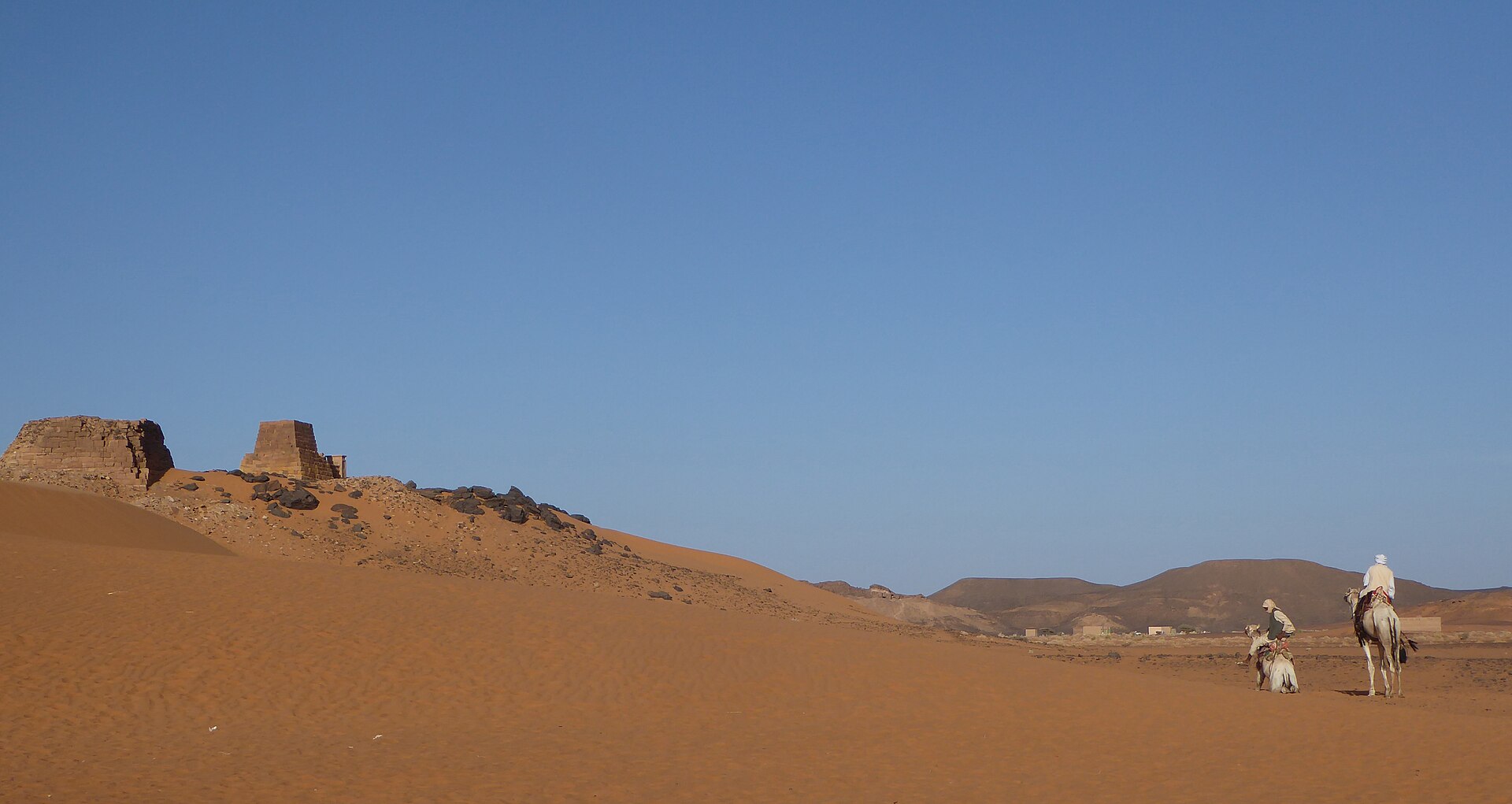
UNESCO describes the property in these words: “The Archaeological Sites of the Island of Meroe, a semi-desert landscape between the Nile and Atbara rivers, was the heartland of the Kingdom of Kush, a major power from the 8th century B.C. to the 4th century A.D. The property consists of the royal city of the Kushite kings at Meroe, near the River Nile, the nearby religious site of Naqa and Musawwarat es Sufra. It was the seat of the rulers who occupied Egypt for close to a century and features, among other vestiges, pyramids, temples and domestic buildings as well as major installations connected to water management. Their vast empire extended from the Mediterranean to the heart of Africa, and the property testifies to the exchange between the art, architectures, religions and languages of both regions.”[1]
Background
Meroë was an ancient city on the east bank of the Nile, about 200 km north-east of Khartoum, near the villages of Bagrawiyah. Wikipedia says it was the capital of the Kingdom of Kush for several centuries from around 590 BC until the kingdom's collapse in the 4th century AD.[2] The 'Island of Meroë' was the region of Butana, between the Nile, the Atbara and the Blue Nile. The article names two other Meroitic cities in Butana, Musawwarat es-Sufra and Naqa.[2]
The pyramids, as National Geographic described them in 2022
National Geographic wrote in 2022 that Sudan has about 255 pyramids, more than twice the number in Egypt, and that Meroë alone has more than 200.[3]
It dates the Kingdom of Kush from 900 BC to AD 400. Of the 41 tombs in Meroë's north cemetery, it says, 38 belong to monarchs who ruled between 250 BC and AD 320.[3]
Unlike Egyptian pyramids, it explains, Nubian burial chambers lie below the pyramids, not inside them. It also reports that sand is slowly swallowing Meroë.[3]
- The pyramids and the site's present condition after the war in Sudan, which the part of the article read here does not reach.
- Sudanese archaeologists' and residents' accounts.
- Local voices: none yet.
- That article was written before the war that began in Sudan in 2023, so it says nothing about the war's effect on the site, and the site's present condition is not covered here.
Sources
- Institutional[1] Archaeological Sites of the Island of Meroe. UNESCO World Heritage Centre, World Heritage List (open data, CC BY-SA 4.0). whc.unesco.org retrieved 7 Oct 2026
Read from UNESCO's open-data record (data.unesco.org, dataset whc001); the web page itself could not be opened from this project's tools. Texts are UNESCO's own. - Encyclopedia · to verify[2] Meroë. Wikipedia. en.wikipedia.org retrieved 7 Oct 2026
Used for background that the UNESCO record does not give. Each statement is limited to the article's lead and opening sections; confirm against specialist sources. - Press[3] Emma Thomson, These mighty pyramids were built by one of Africa's earliest civilizations. National Geographic, 28 Dec 2022. www.nationalgeographic.com retrieved 7 Oct 2026
Published before the 2023 war in Sudan, so it does not report the war's effects.