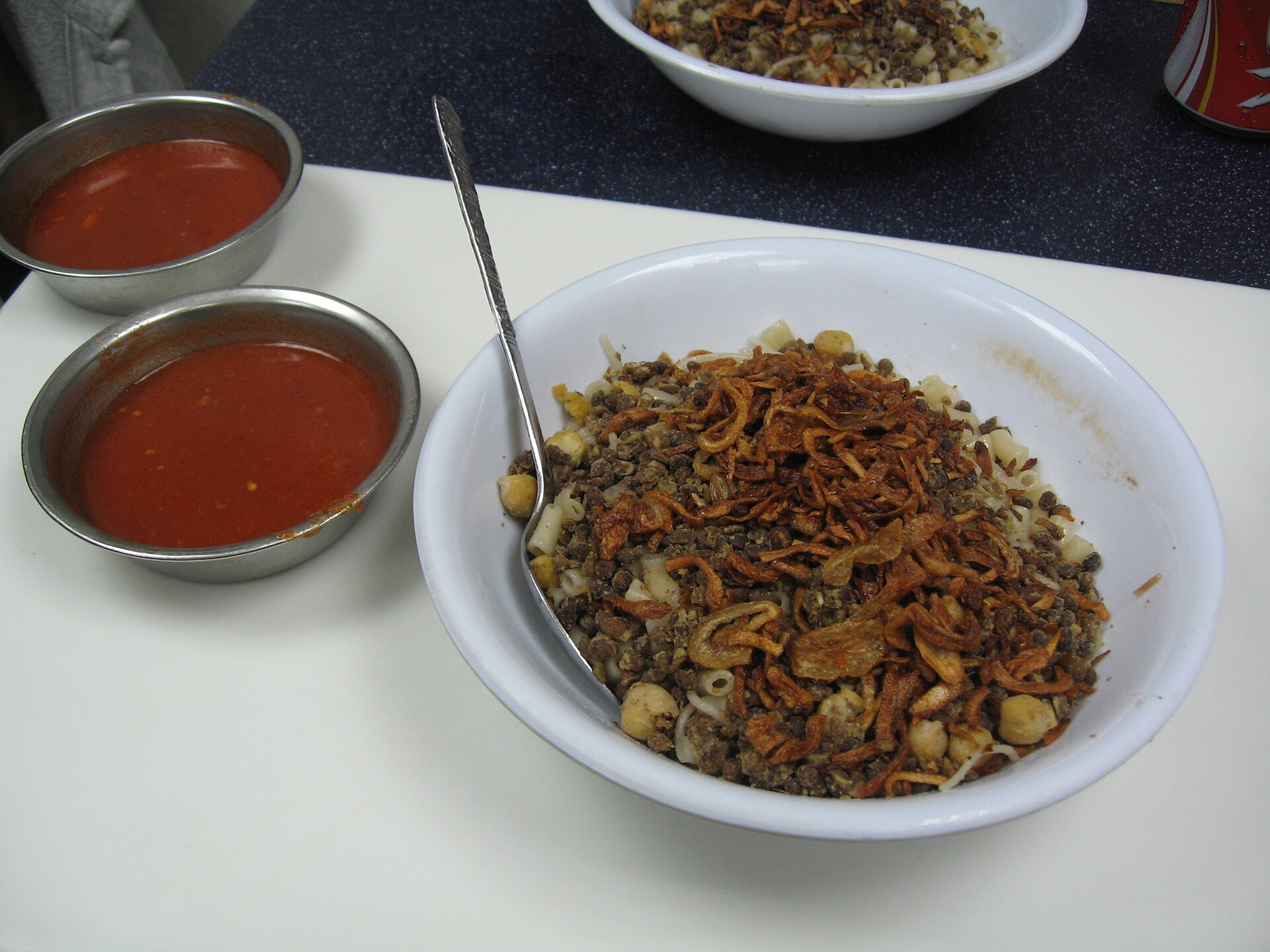
What it is
Koshari is a dish of rice, lentils, chickpeas and pasta, all cooked separately without spices, topped with a peppery hot sauce called shatta, a garlicky vinegar called da'ah, and fried onions.[1] An Egyptian cook describes it as vegan and easy to make for a large family.[2]
A home cook says her tip for a great koshari is to fry the sliced onions first, so that you get a flavoured oil. She makes it most weekends for her children.[2] An Egyptian news site calls it often considered Egypt's national dish.[3]
How it is eaten
Street vendors traditionally prepare it, though it can be made at home. Diners who are not full can ask for a "kemala", extra spoonfuls.[3] It is also cooked at family gatherings, a home cook says, as "a dish made with love".[2]
Where it comes from: three accounts
One account says the dish came from India, where a similar one is called khichri or khichdi, with Indians who accompanied British soldiers to Egypt in the early 1900s, after the First World War; Italian residents are said to have added the pasta.[3]
A home cook gives another date: British colonialism in 1882, when Indians and Italians were based in Egypt, and Egyptians then added the fried onions and the tomato sauce.[2]
A newspaper puts the Indian link in the 1800s, with Italian workers on the Suez Canal arriving by the mid-1800s, and adds that some historians see koshari as developing from the Egyptian mujaddara, a dish of rice, lentils and crisp caramelised onions.[1]
These accounts differ on the date and on who brought what, and this card does not choose between them.
- The origin. The three press articles read give three different dates, from the 1800s to the early 1900s, and none is a historian's study; an Egyptian food historian is needed.
- What Egyptians call koshari at home, which varies from family to family. One cook is quoted, and the others are written for readers abroad.
- Where and when koshari first appeared in Egyptian cookbooks or shops. Nothing read dates its first sale.
- Prices, where to eat it and which places are best known: none of the sources gives them.
- The photograph shows a bowl with sauces on the side; where it was taken is not given on its page.
Sources
- Press[1] Egyptian Koshari, kushari or koshary: a delicious mix of rice, lentils, pasta and cultures. Gulf News. gulfnews.com retrieved 8 Oct 2026
A newspaper food feature; the page read does not show its date, which the web address suggests is December 2021. It sets out several origin theories. - Press[2] Koshari is a regular on this Egyptian family's table. SBS Food (Australia), 24 Jun 2021. www.sbs.com.au retrieved 8 Oct 2026
A home cook, Sahar Elsemary, describes how her family makes koshari, 24 June 2021. A single voice, with her own account of the origin. - Press[3] The history of koshari is as rich as its flavor. Egyptian Streets, 21 Sep 2021. egyptianstreets.com retrieved 8 Oct 2026
An Egyptian independent news site, 21 September 2021. It repeats the most common account of the dish's origin and does not cite a document for it.