Background
Laas Geel is a set of cave formations on the rural outskirts of Hargeisa, Somaliland, in the Maroodi Jeex region. Wikipedia says they hold some of the earliest known cave paintings of domesticated African cattle in the Horn of Africa, and that the rock art is estimated at 4,500 to 5,500 years old.[1]
The paintings, as the British Museum's archive describes them
The British Museum's archive places Laas Geel on a granite outcrop at 950 metres, on the road between Hargeisa and Berbera, where two seasonal rivers meet. Its name means "the camel's well" in Somali, a reference to water near the surface of the dry riverbeds.[2]
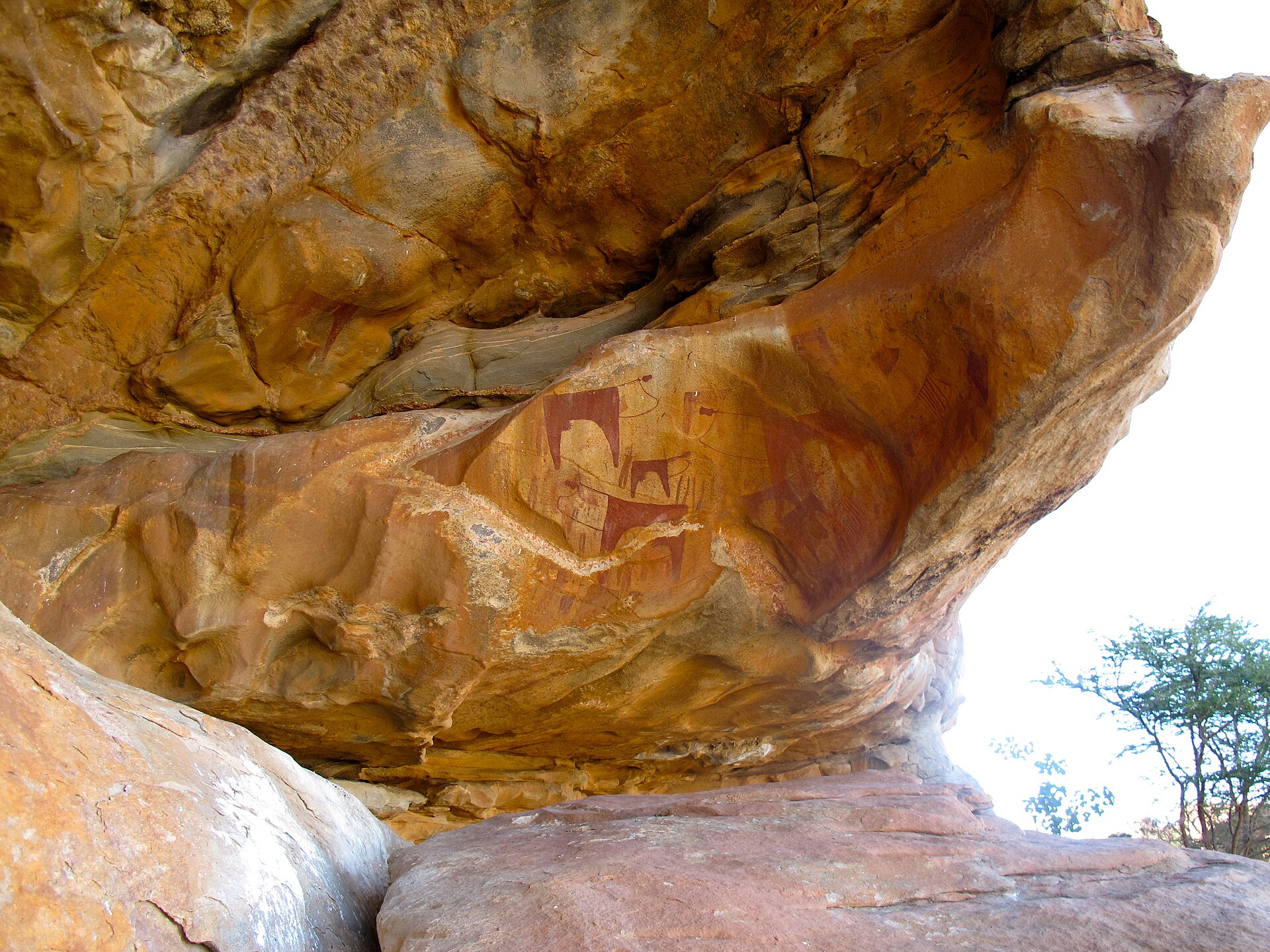
It says the site was discovered in 2002 by a French team led by Xavier Gutherz, and that the paintings are spread over 20 rock shelters, the biggest about 10 metres long. Most show humpless cows with curved, lyre-like white horns, painted in red, white, black, violet, brown and yellow.[2]
The cows' necks are drawn rectangular and abnormally wide, which has been read as mats hung from the neck, perhaps a ceremonial ornament. Human figures with arms outstretched always appear with the cows, and dogs are common, while other animals, such as antelopes, monkeys and two giraffes, are rare.[2]
Unlike many rock art sites it has been dated fairly precisely, because excavation in one shelter recovered fallen painted rock: the archaeologists proposed a chronology from the mid-4th to the mid-3rd millennium.[2]
- Politics of the location: Laas Geel is in Somaliland, whose declared independence from Somalia is not internationally recognised. This card sits under Somalia in the country list; how to present it needs an editorial decision.
- Everything beyond the outline: the paintings, who found them and who protects them today.
- This place was chosen by the project as one of Somalia's best known; Somalia has no site on the World Heritage List.
- Local voices: none yet.
- That is the museum's account: Somali and Somaliland voices on the site are not presented, and the archive does not spell out the era of the proposed dates in the part read here.
Sources
- Encyclopedia · to verify[1] Laas Geel. Wikipedia. en.wikipedia.org retrieved 7 Oct 2026
Used for background that the UNESCO record does not give. Each statement is limited to the article's lead and opening sections; confirm against specialist sources. - Institutional[2] Laas Geel, Somaliland. The British Museum, African Rock Art (with the Trust for African Rock Art). africanrockart.britishmuseum.org retrieved 7 Oct 2026
The site's security certificate did not verify from the tools used; the text was read with verification switched off. The archive places the site in Somaliland.