What UNESCO says
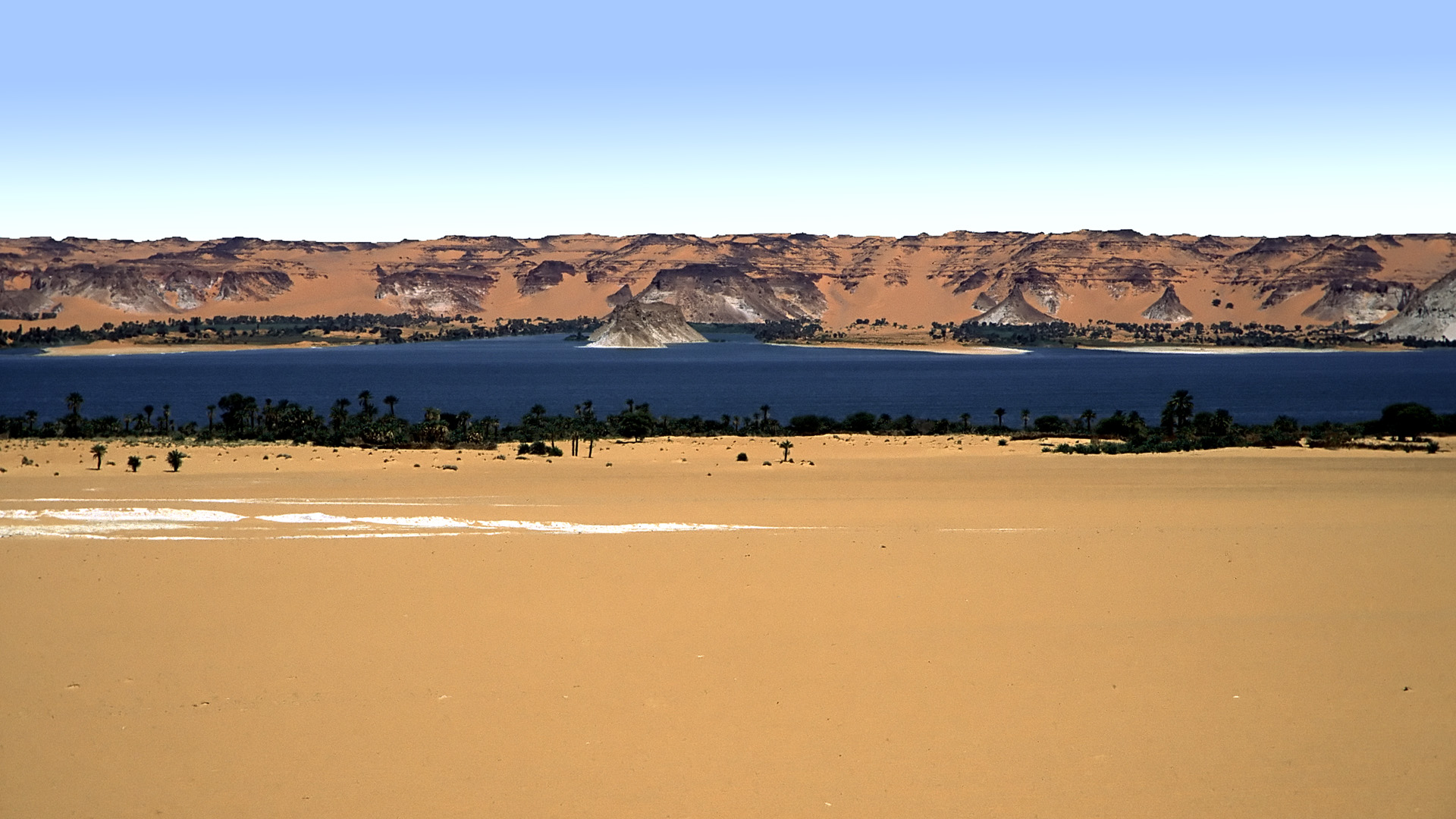
UNESCO describes the property in these words: “The site includes eighteen interconnected lakes in the hyper arid Ennedi region of the Sahara desert covering an area of 62,808 ha. It constitutes an exceptional natural landscape of great beauty with striking colours and shapes. The saline, hyper saline and freshwater lakes are supplied by groundwater and are found in two groups 40 km apart. Ounianga Kebir comprises four lakes, the largest of which, Yoan, covers an area of 358 ha and is 27 m deep. Its highly saline waters only sustain algae and some microorganisms. The second group, Ounianga Serir, comprises fourteen lakes separated by sand dunes. Floating reeds cover almost half the surface of these lakes reducing evaporation. At 436 ha, Lake Teli has the largest surface area but is less than 10 m deep. With their high quality freshwater, some of these lakes are home to aquatic fauna, particularly fish.”[1]
Background
The Lakes of Ounianga are a series of lakes in the Sahara, in a basin in the mountains of west Tibesti and east Ennedi in north-eastern Chad. Wikipedia, citing the UNESCO description, says the desert is hyperarid, with less than 2 millimetres of rain a year.[2] It counts 18 lakes in several groups, with a total surface of about 20 square kilometres. The largest, Lake Yoa, covers about 3.5 square kilometres and is 20 metres deep.[2] The lakes vary in size, depth, chemical composition and colour.[2]
- The communities of Ounianga and what the lakes mean to them: nothing in the article read here.
- The source of the water: the article does not explain it.
- Local voices: none yet.
Sources
- Institutional[1] Lakes of Ounianga. UNESCO World Heritage Centre, World Heritage List (open data, CC BY-SA 4.0). whc.unesco.org retrieved 7 Oct 2026
Read from UNESCO's open-data record (data.unesco.org, dataset whc001); the web page itself could not be opened from this project's tools. Texts are UNESCO's own. - Encyclopedia · to verify[2] Lakes of Ounianga. Wikipedia. en.wikipedia.org retrieved 7 Oct 2026
Used for background that the UNESCO record does not give. Each statement is limited to the article's lead and opening sections; confirm against specialist sources.