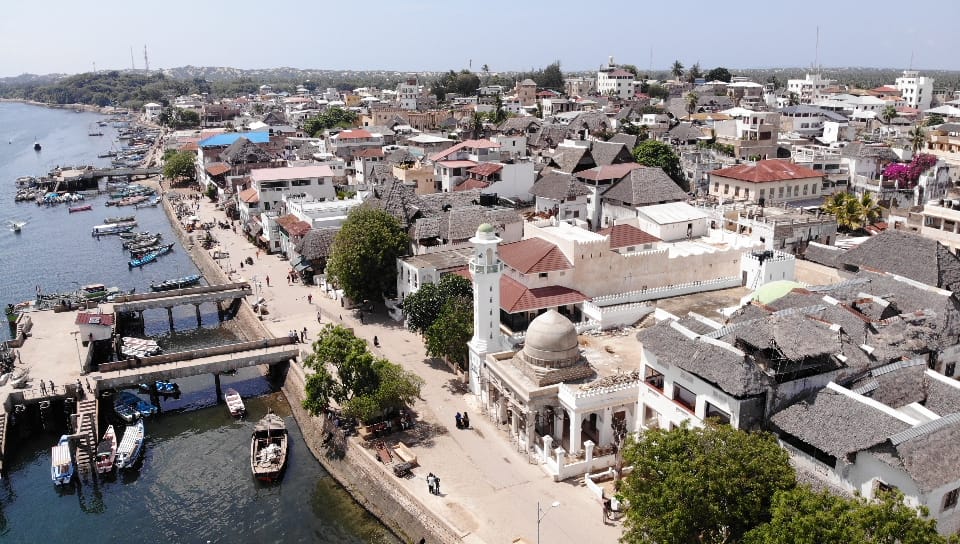
What UNESCO says
UNESCO describes the property in these words: “Lamu Old Town is the oldest and best-preserved Swahili settlement in East Africa, retaining its traditional functions. Built in coral stone and mangrove timber, the town is characterized by the simplicity of structural forms enriched by such features as inner courtyards, verandas, and elaborately carved wooden doors. Lamu has hosted major Muslim religious festivals since the 19th century, and has become a significant centre for the study of Islamic and Swahili cultures.”[1]
Background
Lamu is a small town on Lamu Island, in the Lamu Archipelago in Kenya, 341 kilometres by road north-east of Mombasa. The road ends at Mokowe jetty and a sea channel must be crossed to reach it.[2] Wikipedia says Lamu Fort stands on the seafront and was completed in the early 1820s, and that the town has 23 mosques, among them the Riyadha Mosque of 1900, and a donkey sanctuary. The majority of the population is Muslim.[2] The town is believed to have been established in 1370 and is described as Kenya's oldest continually inhabited town and one of the original Swahili settlements on the coast.[2]
Pressure on the old town, as reported in 2021
France 24 described Lamu in April 2021 as continuously inhabited for more than 700 years and listed by UNESCO in 2001 as "the oldest and best preserved Swahili settlement in East Africa".[3]
The report said that a decade earlier the island had only two vehicles, and that there were now almost 400 motorbike taxis, called boda bodas. A ban on them from the waterfront and from a 16-hectare zone around the old town had been brought in that February.[3]
A UNESCO culture specialist, Karalyn Monteil, warned that Lamu could be placed on the list of heritage sites in danger at the July meeting if nothing was done. Residents disagreed on the ban: the deputy governor said the numbers were surging, while a boda boda cooperative's secretary said young people did not see the benefits.[3]
- Swahili voices on the town today, which the article read here does not reach.
- The Maulidi festival and other living traditions.
- Local voices: none yet.
- The motorbike dispute is as reported in April 2021 and from one news article; the outcome at the July 2021 meeting and the situation now are not covered here.
Sources
- Institutional[1] Lamu Old Town. UNESCO World Heritage Centre, World Heritage List (open data, CC BY-SA 4.0). whc.unesco.org retrieved 7 Oct 2026
Read from UNESCO's open-data record (data.unesco.org, dataset whc001); the web page itself could not be opened from this project's tools. Texts are UNESCO's own. - Encyclopedia · to verify[2] Lamu. Wikipedia. en.wikipedia.org retrieved 7 Oct 2026
Used for background that the UNESCO record does not give. Each statement is limited to the article's lead and opening sections; confirm against specialist sources. - Press[3] Paradise lost? Motorbikes threaten historic Kenyan isle. France 24, 22 Apr 2021. www.france24.com retrieved 7 Oct 2026
A news report from April 2021; figures and warnings are as of then.