What UNESCO says
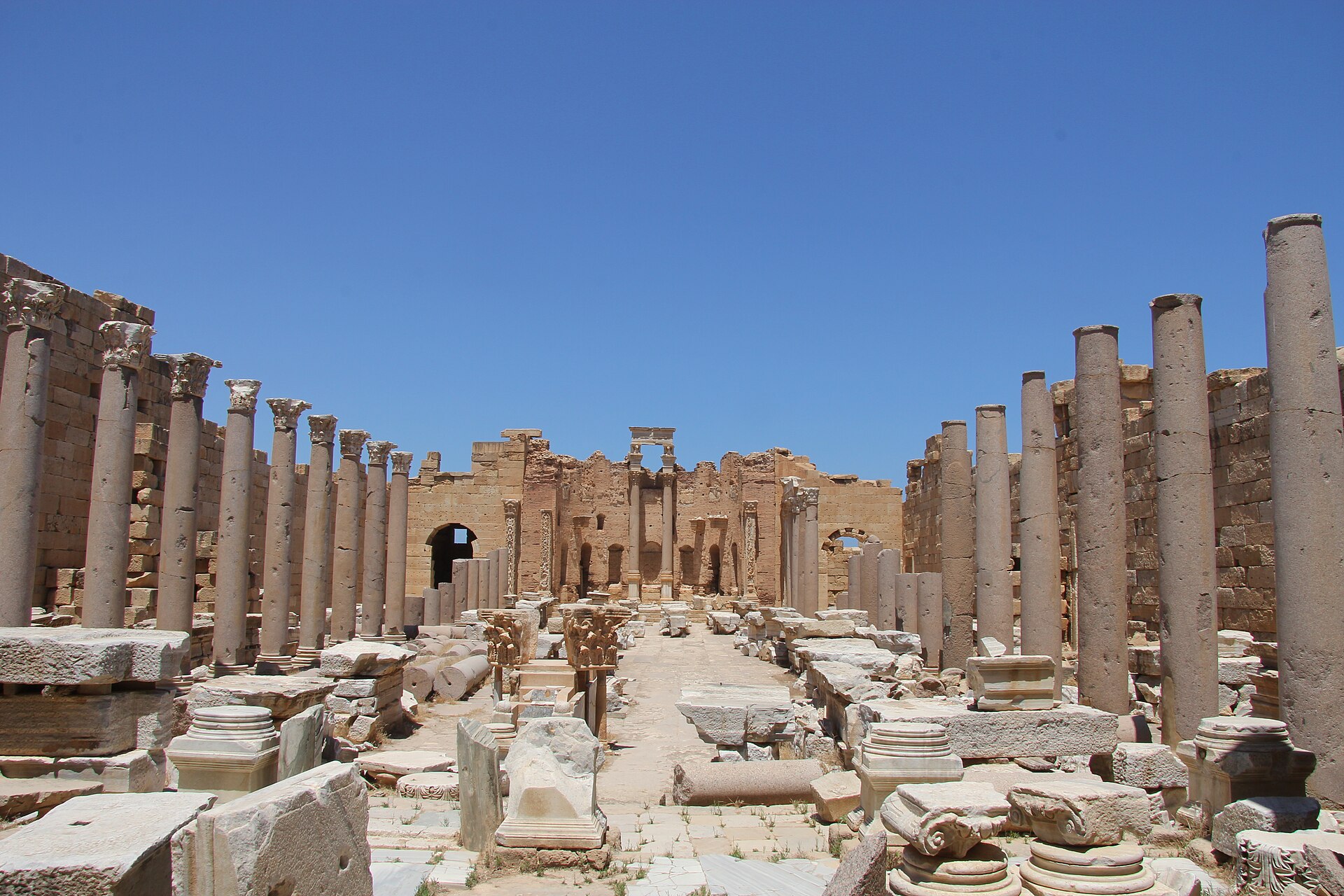
UNESCO describes the property in these words: “Leptis Magna was enlarged and embellished by Septimius Severus, who was born there and later became emperor. It was one of the most beautiful cities of the Roman Empire, with its imposing public monuments, harbour, market-place, storehouses, shops and residential districts.”[1]
Background
Leptis Magna was a city of the Carthaginian Empire and of Roman Libya, at the mouth of the Wadi Lebda on the Mediterranean. Wikipedia says it was a Punic settlement before 500 BC.[2] It grew under Emperor Septimius Severus, who ruled from 193 to 211 and was born there. It fell to the Vandals in 439, rejoined the Eastern Empire in 533, and was abandoned after the Muslim conquest, around 647.[2] The article says that the city lay buried under sand dunes, which preserved it, until Italian archaeologists unearthed it in the 1920s during the Italian occupation of Libya.[2]
Left in the quiet, as reported in 2021
France 24 reported in September 2021 that Leptis Magna, founded by the Phoenicians and later taken by Rome, stands on a hillside with a view of the Mediterranean. It lists a large basilica, a racecourse and a theatre seating up to 15,000 spectators.[3]
It was the birthplace of Septimius Severus, emperor from 193 to 211, who lavished resources on his native city. After the 2011 conflict UNESCO placed it and four other Libyan sites on its list of heritage in danger.[3]
The report says there had been no direct attacks or threats against the site, but that archaeological digs had stopped, maintenance was rushed and superficial, and only a handful of visitors, almost all Libyans, came, 120 kilometres from Tripoli.[3]
- The state of the site after the conflicts in Libya since 2011, which the part of the article read here does not reach.
- Libyan archaeologists' and residents' voices.
- Local voices: none yet.
- The site's condition is as of September 2021 and from one news report: digs, maintenance and visitor numbers have not been checked for later years.
Sources
- Institutional[1] Archaeological Site of Leptis Magna. UNESCO World Heritage Centre, World Heritage List (open data, CC BY-SA 4.0). whc.unesco.org retrieved 7 Oct 2026
Read from UNESCO's open-data record (data.unesco.org, dataset whc001); the web page itself could not be opened from this project's tools. Texts are UNESCO's own. - Encyclopedia · to verify[2] Leptis Magna. Wikipedia. en.wikipedia.org retrieved 7 Oct 2026
Used for background that the UNESCO record does not give. Each statement is limited to the article's lead and opening sections; confirm against specialist sources. - Press[3] Jewel of Roman Empire lies neglected in Libya chaos. France 24, 26 Sep 2021. www.france24.com retrieved 7 Oct 2026
A news report from September 2021.