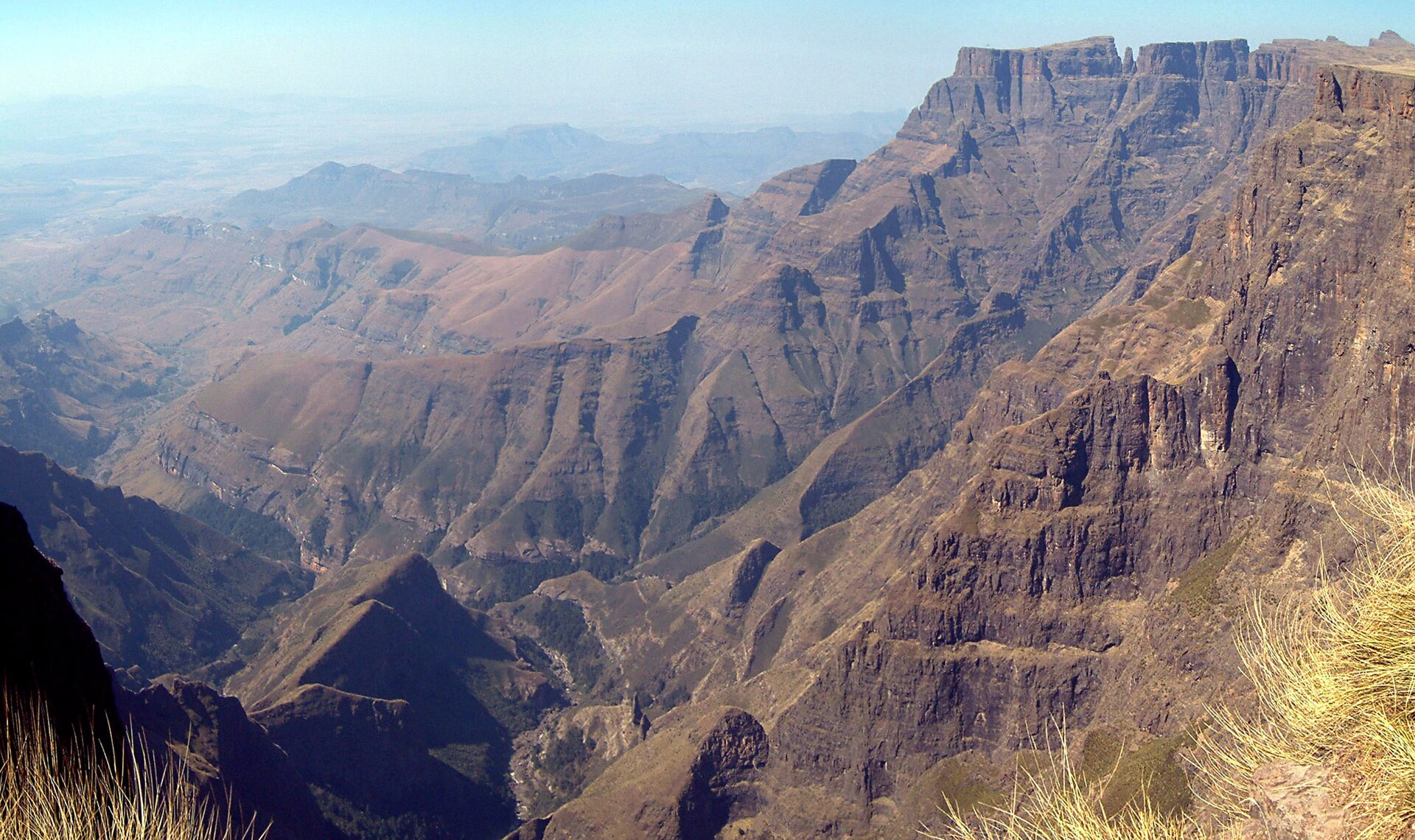
What UNESCO says
UNESCO describes the property in these words: “The Maloti-Drakensberg Park is a transnational property composed of the uKhahlamba Drakensberg National Park in South Africa and the Sehlathebe National Park in Lesotho. The site has exceptional natural beauty in its soaring basaltic buttresses, incisive dramatic cutbacks, and golden sandstone ramparts as well as visually spectacular sculptured arches, caves, cliffs, pillars and rock pools. The site's diversity of habitats protects a high level of endemic and globally important plants. The site harbors endangered species such as the Cape vulture (Gyps coprotheres) and the bearded vulture (Gypaetus barbatus). Lesotho’s Sehlabathebe National Park also harbors the Maloti minnow (Pseudobarbus quathlambae), a critically endangered fish species only found in this park. This spectacular natural site contains many caves and rock-shelters with the largest and most concentrated group of paintings in Africa south of the Sahara. They represent the spiritual life of the San people, who lived in this area over a period of 4,000 years.”[1]
Background
Wikipedia says the park was established on 11 June 2001 by linking Sehlabathebe National Park in Lesotho and the uKhahlamba Drakensberg Park in KwaZulu-Natal, South Africa. Its highest peak is Thaba Ntlenyana, 3,482 metres.[2] It describes the Drakensberg as the highest ground in the sub-region, with montane and sub-alpine ecosystems of globally significant diversity and high endemism.[2] The article also says the park holds the greatest gallery of rock art in the world, with hundreds of sites and many thousands of images painted by the San, and that the wider transfrontier area was conceived as a peace park of about 8,113 km², 64 percent of it in Lesotho.[2]
One shelter: Game Pass, as the British Museum's archive describes it
The British Museum's archive says the Drakensberg mountains are known for their wealth of rock paintings by San communities, often showing people, animals and part-human, part-animal figures called therianthropes. Game Pass Shelter, in the foothills, is one of South Africa's best-known sites.[3]
Its best-known panel, about 50 centimetres long, shows an eland with its face turned to the viewer and legs crossed as if stumbling, its tail grasped by a therianthrope with hooves. In the early 1970s David Lewis-Williams, studying a copy of it, began to think the figure might be "idiomatic and metaphorical, rather than illustrative", an idea partly inspired by testimony from a San man named Qing, who in 1873 guided a colonial official to rock art sites in Lesotho.[3]
- San voices on the rock art and the landscape, and how Basotho and Zulu communities use the mountains.
- How the two countries manage the park together, which the article summarises in one line.
- Local voices: none yet.
- That archive page is about one shelter on the South African side: the Lesotho side of the park and Basotho voices are not covered. The interpretation of the paintings, which draws on a San man's 1873 testimony given to a colonial official, is one researcher's view.
Sources
- Institutional[1] Maloti-Drakensberg Park. UNESCO World Heritage Centre, World Heritage List (open data, CC BY-SA 4.0). whc.unesco.org retrieved 7 Oct 2026
Read from UNESCO's open-data record (data.unesco.org, dataset whc001); the web page itself could not be opened from this project's tools. Texts are UNESCO's own. - Encyclopedia · to verify[2] Maloti-Drakensberg Park. Wikipedia. en.wikipedia.org retrieved 7 Oct 2026
Used for background that the UNESCO record does not give. Each statement is limited to the article's lead and opening sections; confirm against specialist sources. - Institutional[3] Game Pass Shelter, South Africa. The British Museum, African Rock Art (with the Trust for African Rock Art). africanrockart.britishmuseum.org retrieved 7 Oct 2026
The site's security certificate did not verify from the tools used; the text was read with verification switched off. About one shelter in the Drakensberg foothills, on the South African side, not the whole Maloti-Drakensberg Park.