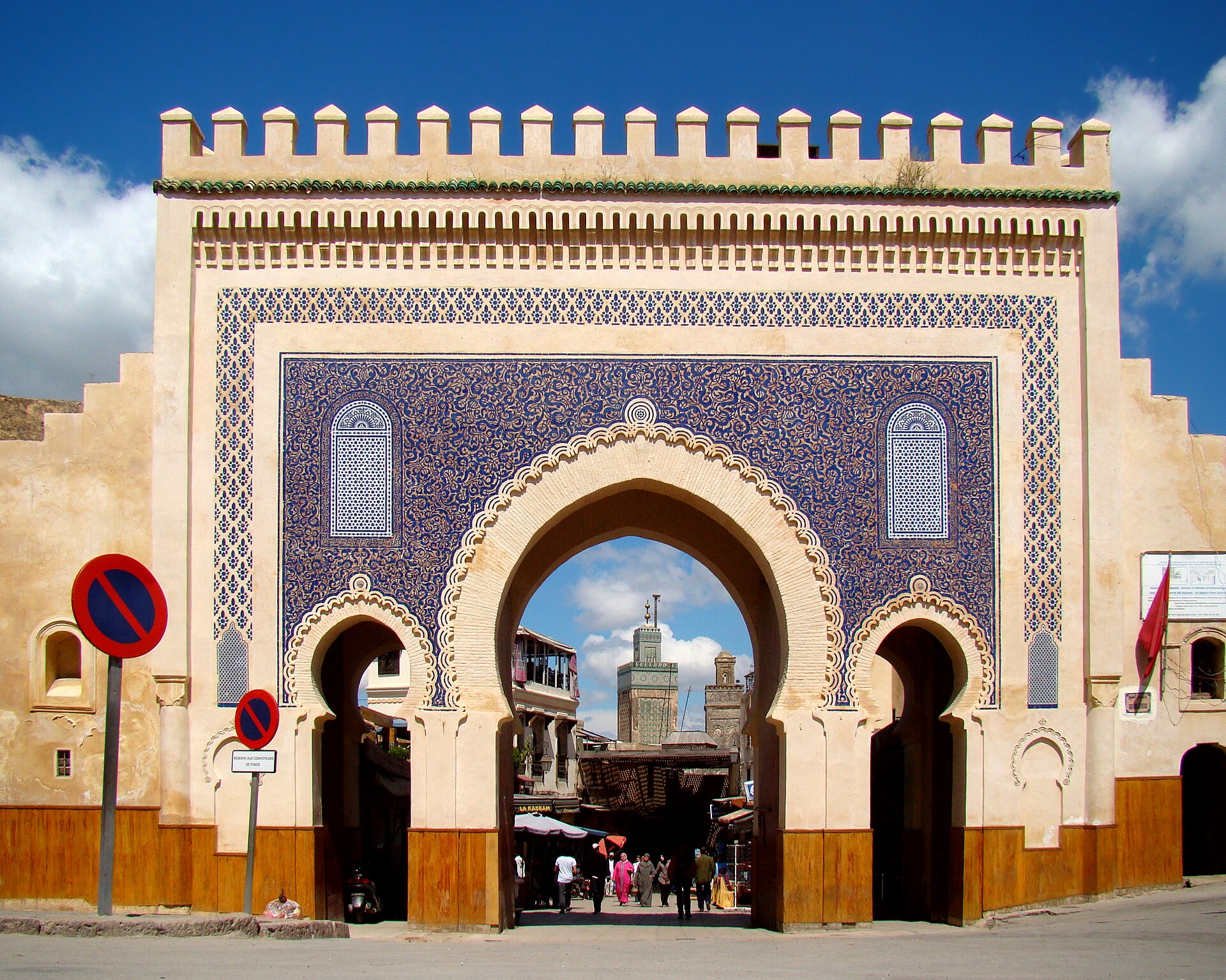
What UNESCO says
UNESCO describes the property in these words: “Founded in the 9th century, Fez reached its height in the 13th–14th centuries under the Marinids, when it replaced Marrakesh as the capital of the kingdom. The urban fabric and the principal monuments in the medina – madrasas, fondouks, palaces, residences, mosques and fountains - date from this period. Although the political capital of Morocco was transferred to Rabat in 1912, Fez has retained its status as the country's cultural and spiritual centre.”[1]
Background
Fes el Bali is the oldest part of Fez. Together with Fes Jdid it forms the medina, valued, Wikipedia says, for keeping its pre-modern urban layout and many historic monuments.[2] It was founded as the capital of the Idrisid dynasty between 789 and 808 AD, as two separate towns on either side of the Fez River that merged under the Almoravids in the 11th and 12th centuries.[2] The Marinids built Fes Jdid next to it in the 13th century as a new administrative capital. Fes el Bali keeps its market streets, narrow alleys and large parts of its walls, with the al-Qarawiyyin University and mosque at its heart.[2]
A seat of learning, as reported in 2016
Al Jazeera called al-Qarawiyyin, in Fez, the oldest university in the world, founded in AD 859, and described it as a prestigious centre of science and technology.[3]
Its library keeps rare manuscripts by medieval scholars. The library's curator, Abdelfattah Bougchouf, said people come from all over the world just to check facts on a page of one manuscript.[3]
To deal with decay and humidity, the restoration installed gutter systems, solar panels and air-conditioning.[3]
- The craft quarters, such as the tanneries, and the artisans' own accounts: the article read here does not describe them.
- Local voices: none yet.
- The "oldest university" and AD 859 claims are the article's own and widely repeated: a historian of education should confirm them. Nothing here yet on the craft quarters, housing, or the state of the rest of the medina.
Sources
- Institutional[1] Medina of Fez. UNESCO World Heritage Centre, World Heritage List (open data, CC BY-SA 4.0). whc.unesco.org retrieved 7 Oct 2026
Read from UNESCO's open-data record (data.unesco.org, dataset whc001); the web page itself could not be opened from this project's tools. Texts are UNESCO's own. - Encyclopedia · to verify[2] Fes el Bali. Wikipedia. en.wikipedia.org retrieved 7 Oct 2026
Used for background that the UNESCO record does not give. Each statement is limited to the article's lead and opening sections; confirm against specialist sources. - Press[3] Morocco restores world's oldest university. Al Jazeera, 21 Oct 2016. www.aljazeera.com retrieved 7 Oct 2026
The 'oldest university' and AD 859 claims are the article's own and are widely repeated; a historian of education should confirm them.