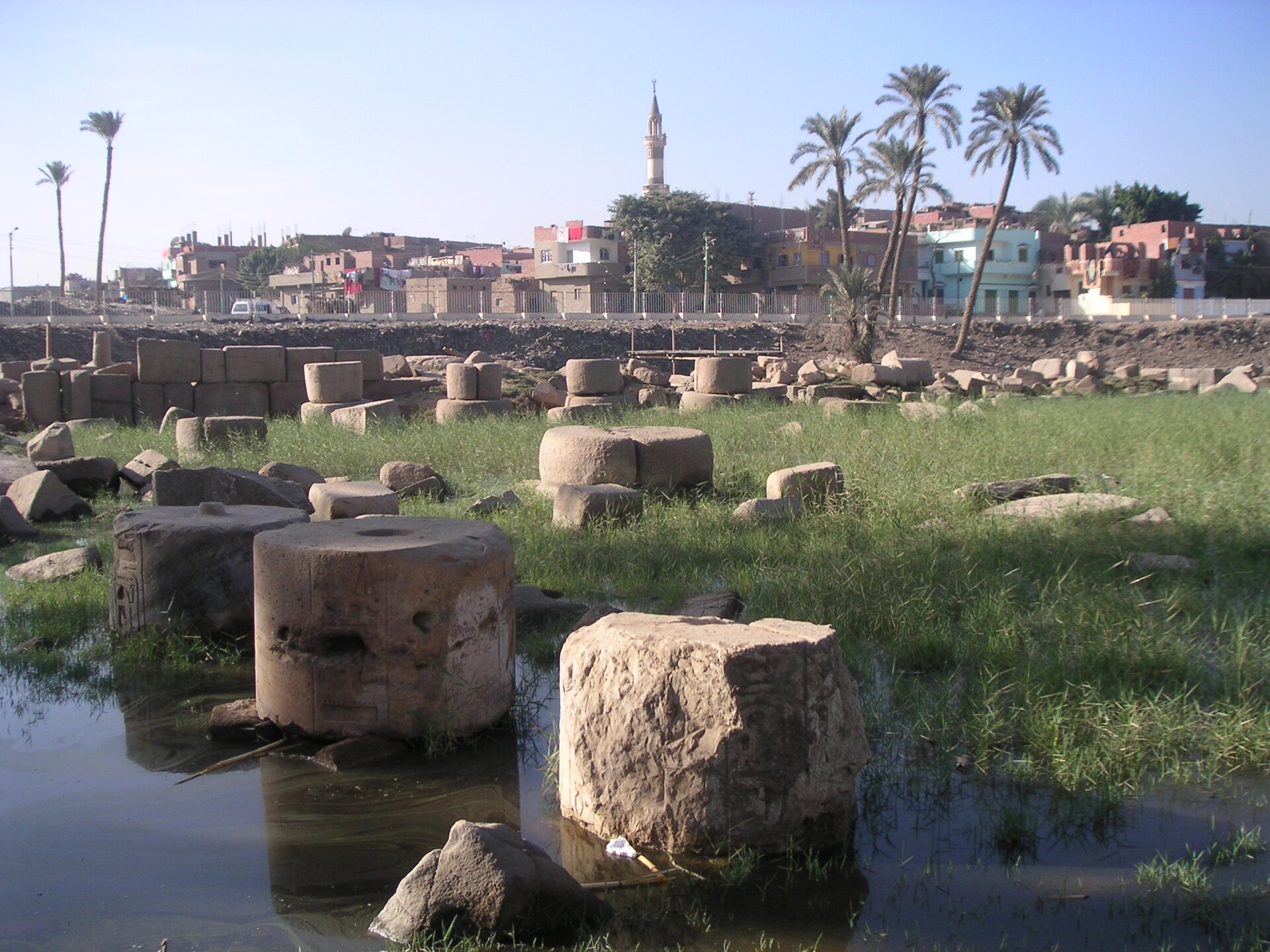
What UNESCO says
UNESCO describes the property in these words: “The capital of the Old Kingdom of Egypt has some extraordinary funerary monuments, including rock tombs, ornate mastabas, temples and pyramids. In ancient times, the site was considered one of the Seven Wonders of the World.”[1]
Background
Memphis was the ancient capital of the first nome of Lower Egypt. Wikipedia says its ruins are near the village of Mit Rahina, in Giza Governorate, and that the pyramid fields that stretch for more than 30 kilometres on its west, including the Pyramids of Giza, are listed with it.[2] It says the site is open to the public as an open-air museum.[2] The article says that, according to Manetho, a priest and historian of the third century BC, King Menes founded the city, and that it was the capital in the Early Dynastic Period and the Old Kingdom and stayed important throughout ancient Egyptian history.[2]
One statue from Memphis, as reported in 2018
National Geographic reported in January 2018 on the move of a granite colossus of Ramesses II, 83 tons and more than 30 feet high, to the Grand Egyptian Museum. It had been carried from the quarries of Aswan to the Temple of Ptah in Memphis in the 13th century BC.[3]
It was rediscovered in 1820 by Giovanni Battista Caviglia, lying on its side in six pieces, and had rested in the ruins of Memphis for more than 130 years. In 1954 President Nasser ordered it brought to Cairo, and in 2006 it was moved to Giza over fears that car emissions were damaging it.[3]
- The pyramids themselves: this card covers only the ancient city as described in the article's first lines.
- Egyptian archaeologists' work on the necropolis and living communities around the site.
- Local voices: none yet.
- That article is about one statue, not the whole site: Memphis's history, the Saqqara tombs and the excavations are not covered by it.
Sources
- Institutional[1] Memphis and its Necropolis – the Pyramid Fields from Giza to Dahshur. UNESCO World Heritage Centre, World Heritage List (open data, CC BY-SA 4.0). whc.unesco.org retrieved 7 Oct 2026
Read from UNESCO's open-data record (data.unesco.org, dataset whc001); the web page itself could not be opened from this project's tools. Texts are UNESCO's own. - Encyclopedia · to verify[2] Memphis, Egypt. Wikipedia. en.wikipedia.org retrieved 7 Oct 2026
Used for background that the UNESCO record does not give. Each statement is limited to the article's lead and opening sections; confirm against specialist sources. - Press[3] Kristin Romey, Ancient Ramses II statue moved to Grand Egyptian Museum. National Geographic, 25 Jan 2018. www.nationalgeographic.com retrieved 7 Oct 2026
About one statue found at Memphis, not the whole site.