What UNESCO says
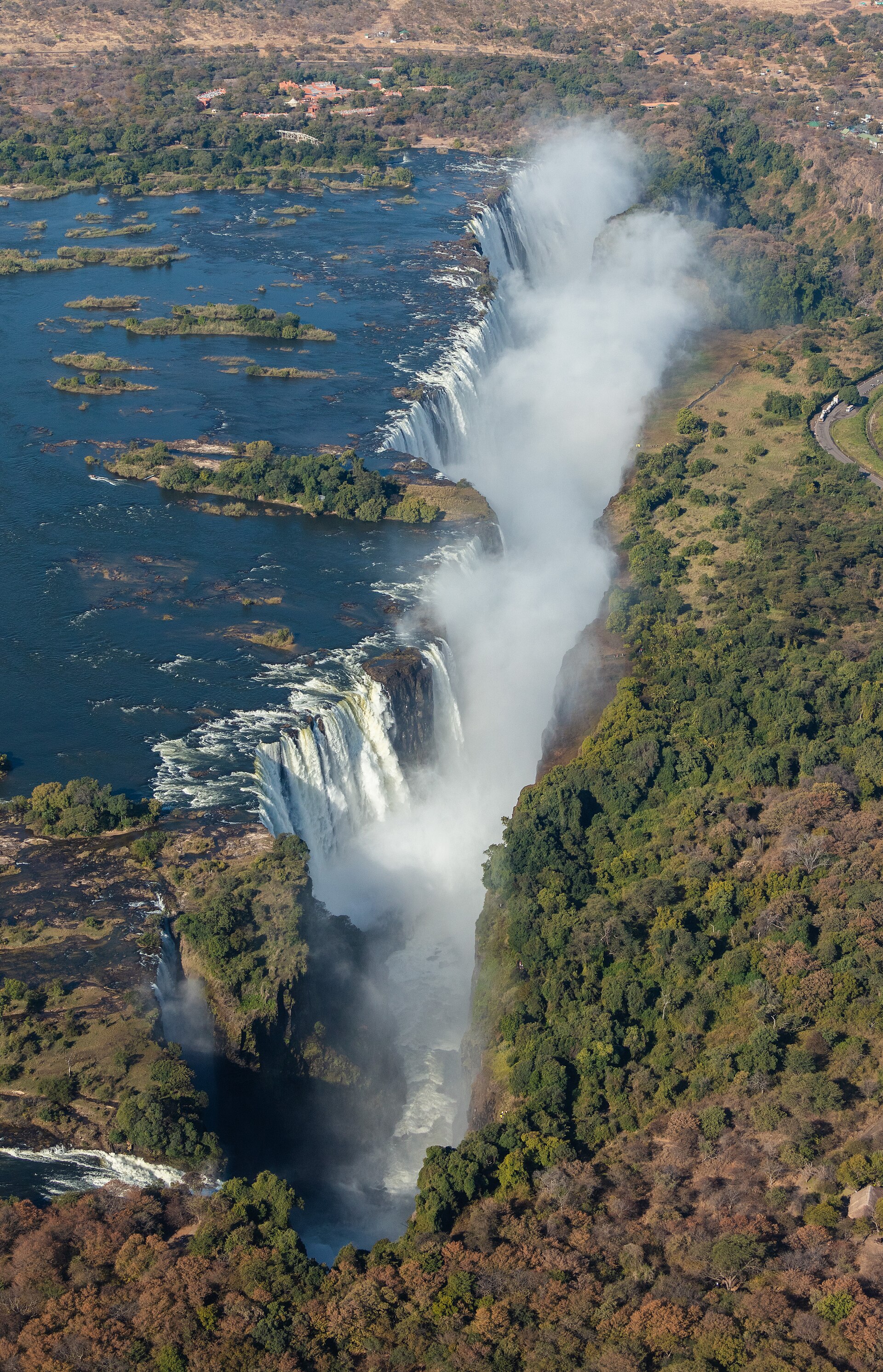
UNESCO describes the property in these words: “These are among the most spectacular waterfalls in the world. The Zambezi River, which is more than 2 km wide at this point, plunges noisily down a series of basalt gorges and raises an iridescent mist that can be seen more than 20 km away.”[1]
Background
Victoria Falls, called Mosi-oa-Tunya ('smoke that thunders') in Lozi, is a waterfall on the Zambezi River on the border between Zambia and Zimbabwe. Wikipedia gives its width as 1,708 metres.[2] The article says archaeology and oral history describe a long African knowledge of the site, and that David Livingstone was introduced to it on 16 November 1855 and named it after Queen Victoria.[2] Both countries have national parks and tourism infrastructure there. Research in the late 2010s found that changing rainfall due to climate change is likely to alter the character of the falls.[2]
Names, and a first-hand account
The David Livingstone Birthplace Trust gives the falls as 108 metres high, twice the height of Niagara, and says the spray can be seen from 18 miles away.[3]
It records an older name, Shongwe, and the name given by the Makololo, Mosi-oa-tunya, "the smoke that thunders". Livingstone, who reached the falls on 16 November 1855, wrote that he used the same liberty as the Makololo in naming them after Queen Victoria.[3]
He travelled with an expedition led by Sekeletu, the new Makololo chief, of about 200 men, and reached an island at the edge of the falls by canoe with men who knew the rapids. He cut his initials into a tree and planted peach seeds, and found the saplings eaten by hippopotamuses on his return in 1860.[3] He wrote that it was a hopeless task to convey an idea of the falls in words.[3]
- Tourism, river flow and the effects of drought on the falls, which the part read here only mentions.
- Local voices: none yet.
- The account in "Names, and a first-hand account" is told through Livingstone's own writing by a trust devoted to him: Lozi, Tonga and other local names and stories are not covered beyond the two names given there.
Sources
- Institutional[1] Mosi-oa-Tunya / Victoria Falls. UNESCO World Heritage Centre, World Heritage List (open data, CC BY-SA 4.0). whc.unesco.org retrieved 7 Oct 2026
Read from UNESCO's open-data record (data.unesco.org, dataset whc001); the web page itself could not be opened from this project's tools. Texts are UNESCO's own. - Encyclopedia · to verify[2] Victoria Falls. Wikipedia. en.wikipedia.org retrieved 7 Oct 2026
Used for background that the UNESCO record does not give. Each statement is limited to the article's lead and opening sections; confirm against specialist sources. - Institutional[3] The Smoke That Thunders. David Livingstone Birthplace Trust. www.david-livingstone-birthplace.org retrieved 7 Oct 2026
A museum trust devoted to Livingstone: the page tells the visit mainly through his own account.