What UNESCO says
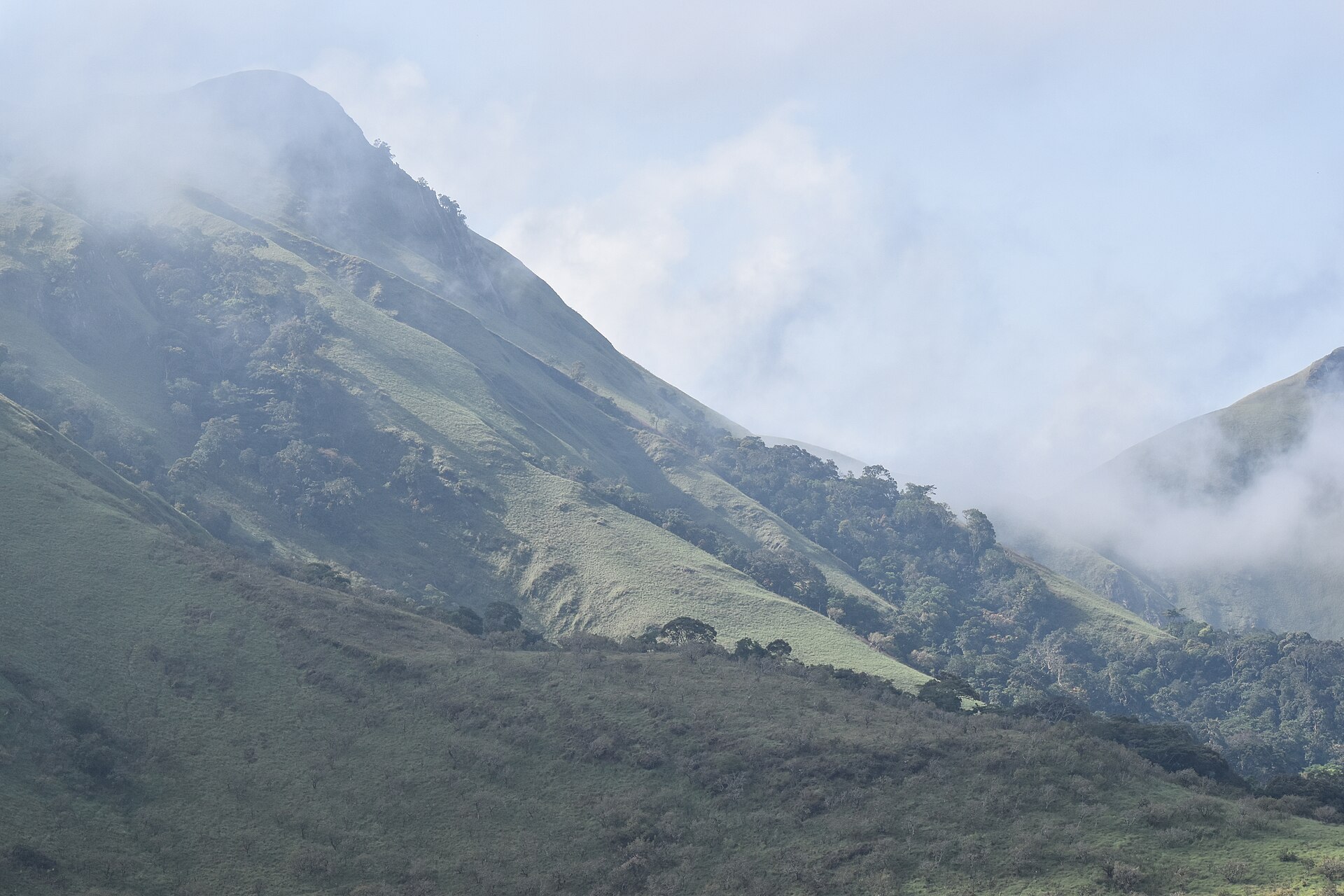
UNESCO describes the property in these words: “Located on the borders of Guinea, Liberia and Côte d’Ivoire, Mount Nimba rises above the surrounding savannah. Its slopes are covered by dense forest at the foot of grassy mountain pastures. They harbour an especially rich flora and fauna, with endemic species such as the viviparous toad and chimpanzees that use stones as tools.”[1]
Background
The reserve covers 175.4 km², of which 125.4 km² are in Guinea and 50 km² in Côte d'Ivoire. Its highest point, Mount Richard-Molard at 1,752 metres, is the highest peak of both countries.[2] Wikipedia notes exceptional numbers of species found nowhere else, among them a genus of live-bearing toads, the Nimba otter shrew and several horseshoe bats.[2] The reserve was created in 1943 in Côte d'Ivoire and in 1944 in Guinea. The two parts were inscribed on the World Heritage List in 1981 (Guinea) and 1982 (Côte d'Ivoire). Iron-ore exploration in the most fragile mountain zone began in 1992.[2]
The mine and the reserve, as reported in January 2026
Le Monde, in an English translation, reported in January 2026 that the reserve has been a strict nature reserve since a French colonial decree of 1944, was listed in 1981 and was placed on the danger list in 1992, and that about fifty rivers rise there.[3]
A mining project called Kon Kweni, "iron stones" in Kono, would take 2 to 5 million tonnes a year for its first decade from a 15-square-kilometre enclave inside the reserve. The Guinea Iron Ore Mining Company, 85% owned by Ivanhoe Atlantic and 10% by the Guinean state, was awaiting government approval.[3]
Conservation organisations warned of irreversible destruction and asked for a renewable five-year moratorium. The article names the western chimpanzee, critically endangered, and a toad of about two centimetres that it calls the only known viviparous toad in the world, among the species at risk.[3]
- The mining dispute and its present state, which Wikipedia only begins to describe in the part read here.
- The communities around the mountain and how they use it.
- Local voices: none yet.
- The mine's status is as of January 2026 and from one translated article: whether it has since been approved is not covered here. Residents' and the Guinean authorities' own accounts are not included.
Sources
- Institutional[1] Mount Nimba Strict Nature Reserve. UNESCO World Heritage Centre, World Heritage List (open data, CC BY-SA 4.0). whc.unesco.org retrieved 7 Oct 2026
Read from UNESCO's open-data record (data.unesco.org, dataset whc001); the web page itself could not be opened from this project's tools. Texts are UNESCO's own. - Encyclopedia · to verify[2] Mount Nimba Strict Nature Reserve. Wikipedia. en.wikipedia.org retrieved 7 Oct 2026
Used for background that the UNESCO record does not give. Each statement is limited to the article's lead and opening sections; confirm against specialist sources. - Press[3] In Guinea, a viviparous toad, chimpanzees and bats face the iron mine in the Nimba Mountains (English translation). Le Monde, translated by CRI, 22 Jan 2026. cri.org retrieved 7 Oct 2026
A translation of a Le Monde article posted by CRI. The mining project was awaiting approval when it was written.