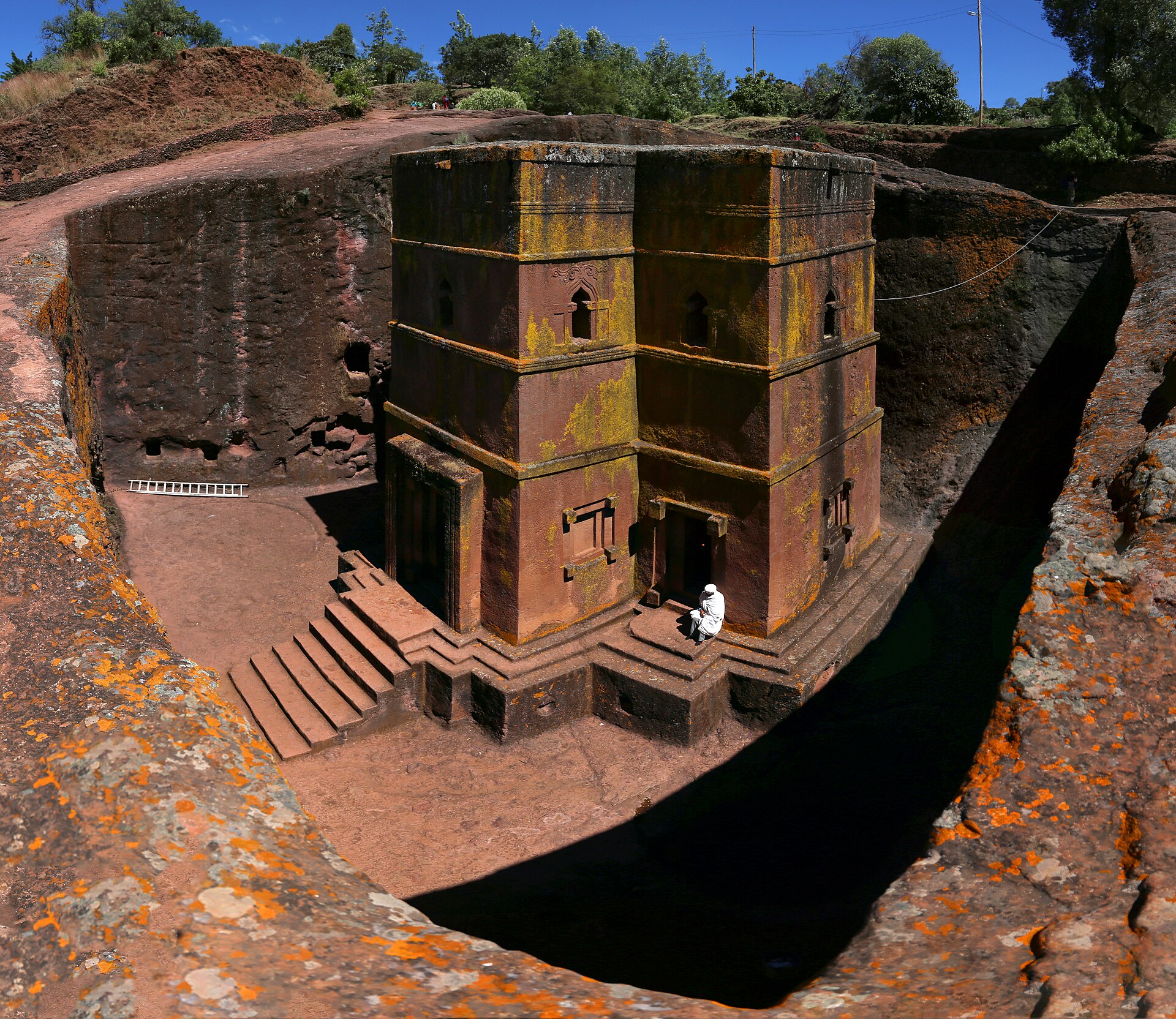
What UNESCO says
UNESCO describes the property in these words: “The 11 medieval monolithic cave churches of this 13th-century 'New Jerusalem' are situated in a mountainous region in the heart of Ethiopia near a traditional village with circular-shaped dwellings. Lalibela is a high place of Ethiopian Christianity, still today a place of pilmigrage and devotion.”[1]
Background
Wikipedia describes eleven monolithic churches near the town of Lalibela, in the Ethiopian Highlands, named after King Gebre Meskel Lalibela of the Zagwe dynasty. The tradition says he built them to recreate Jerusalem.[2] It says the site is still in use by the Ethiopian Orthodox Church and is a major pilgrimage place, and that building took 24 years.[2] The article reports local tradition that Lalibela, formerly Roha, was founded by an Agew family, the Zagwe, in 1137, and says the churches probably reached their present form over several phases of construction rather than in one reign.[2]
A place of pilgrimage, as reported by Africanews
Africanews describes the eleven churches as chiselled out of rock, with roofs at ground level and the largest more than 12 metres high. By legend, King Lalibela was instructed by Jesus Christ to build a second Jerusalem for African pilgrims.[3]
The town was capital of the Zagwe dynasty in the 12th and 13th centuries and is now one of Ethiopia's holiest cities, second only to Aksum. The area remains a centre of pilgrimage, and the population is almost entirely Ethiopian Orthodox.[3]
The report says that after some 800 years torrential rain and blistering sun have taken a toll and the buildings are starting to crumble and crack, and that the World Heritage Committee was discussing whether to list the site as in danger.[3]
- Ethiopian Orthodox accounts of the churches and of the pilgrimage, which the article only summarises.
- The protective roofs and conservation disputes, and the present state of the town.
- Local voices: none yet.
- Sources differ on when the churches were built: this news report says the end of the 11th and beginning of the 12th century, which is earlier than the dates other sources give. The card does not settle it; an art historian's account should.
Sources
- Institutional[1] Rock-Hewn Churches, Lalibela. UNESCO World Heritage Centre, World Heritage List (open data, CC BY-SA 4.0). whc.unesco.org retrieved 7 Oct 2026
Read from UNESCO's open-data record (data.unesco.org, dataset whc001); the web page itself could not be opened from this project's tools. Texts are UNESCO's own. - Encyclopedia · to verify[2] Rock-Hewn Churches, Lalibela. Wikipedia. en.wikipedia.org retrieved 7 Oct 2026
Used for background that the UNESCO record does not give. Each statement is limited to the article's lead and opening sections; confirm against specialist sources. - Press[3] Is Ethiopia's Lalibela, known as the 'Second Jerusalem', in danger?. Africanews, 13 Aug 2024. www.africanews.com retrieved 7 Oct 2026
Written in July 2021 and last updated 13 August 2024. Its construction dates differ from some other sources.