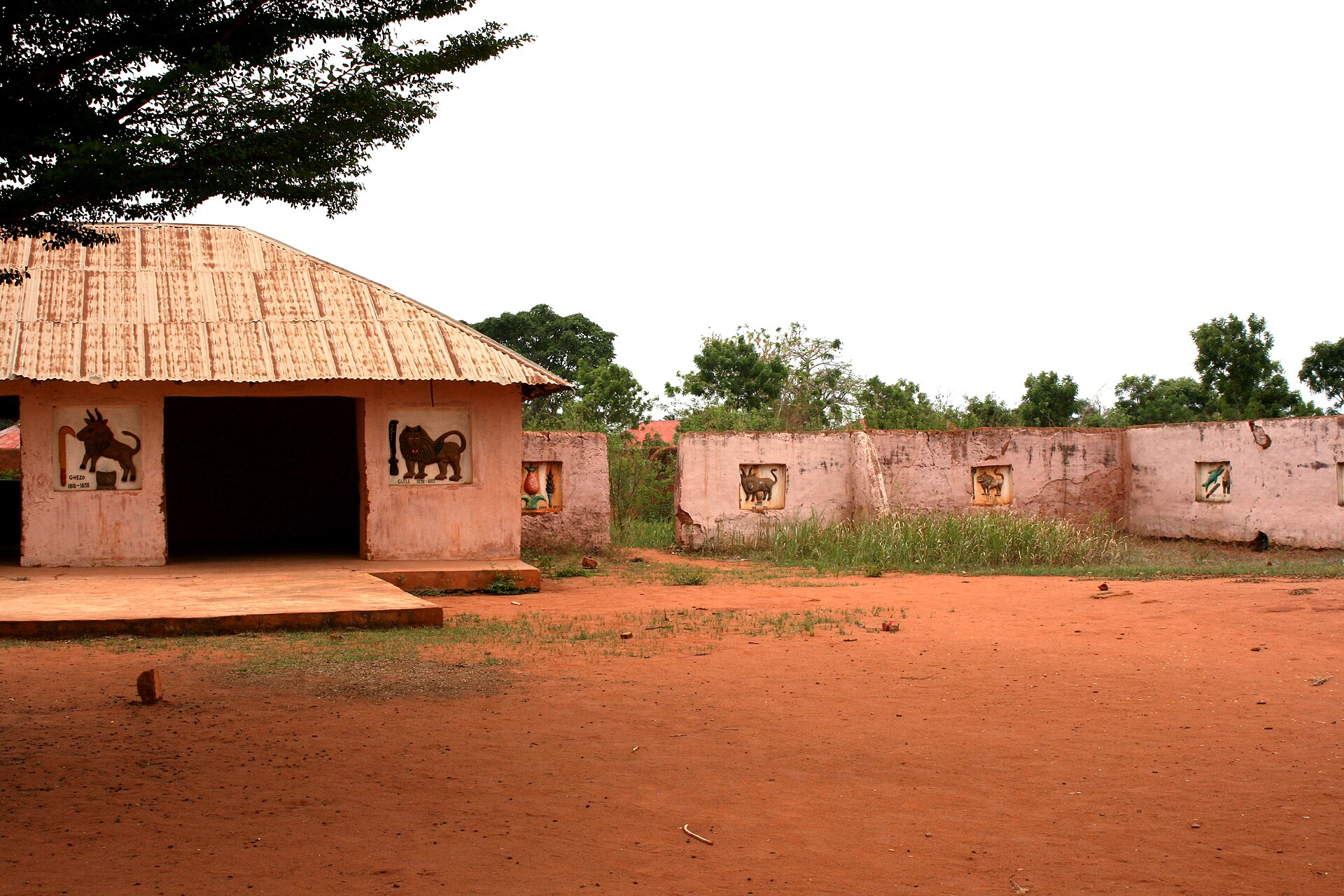
What UNESCO says
UNESCO describes the property in these words: “From 1625 to 1900, 12 kings succeeded one another at the head of the powerful Kingdom of Abomey. With the exception of King Akaba, who had his own separate enclosure, they all had their palaces built within the same cob-wall area, in keeping with previous palaces as regards the use of space and materials. The royal palaces of Abomey are a unique reminder of this vanished kingdom.”[1]
The kings and their city
A 2023 popular-history article says two traditions recorded in the 18th century give different founders for Abomey: the chief Dakodonu, who died in 1645, or Houegbadja, the first king of Dahomey, who reigned from 1645 to 1685.[2] It lists the succession as Houegbadja, Akaba (1685–1708), Agaja, Tegbesu (1740–1774), Kpengla (1774–1789), Agonglo (1789–1797), Adandozan, Gezo (1818–1858), Glele (1858–1889) and Béhanzin (1889–1894).[2] The complex held about a dozen royal residences and many other buildings. The article puts it at over a hundred acres, inside a city wall about 30 feet tall that ran for some 2.5 miles.[2]
When the French army marched on Abomey in 1892–94, the same article says, Béhanzin saw that resistance was futile, left to set up a capital in the north, and ordered the palace complex razed, preferring that to leaving the sacred tombs and soul-houses to the enemy.[2]
- A specialist history of Dahomey to confirm the dates of the reigns, which differ between published lists, and the account of the 1892–94 war.
- The museum today: what it shows, who runs it and how it tells this history.
- The 2007 removal from the Danger List, and the restoration work since (the sources found are summaries, not the reports).
- Local voices: none yet.
Sources
- Institutional[1] Royal Palaces of Abomey. UNESCO World Heritage Centre, World Heritage List (open data, CC BY-SA 4.0). whc.unesco.org retrieved 7 Oct 2026
Read from UNESCO's open-data record (data.unesco.org, dataset whc001); the web page itself could not be opened from this project's tools. Texts are UNESCO's own. - Press · to verify[2] A complete history of Abomey: capital of Dahomey (ca. 1650–1894). African History Extra, by Isaac Samuel (10 September 2023). www.africanhistoryextra.com retrieved 7 Oct 2026
A popular-history newsletter, not a peer-reviewed source. Dates of reigns are as the article gives them; check them against a specialist history of Dahomey.