What UNESCO says
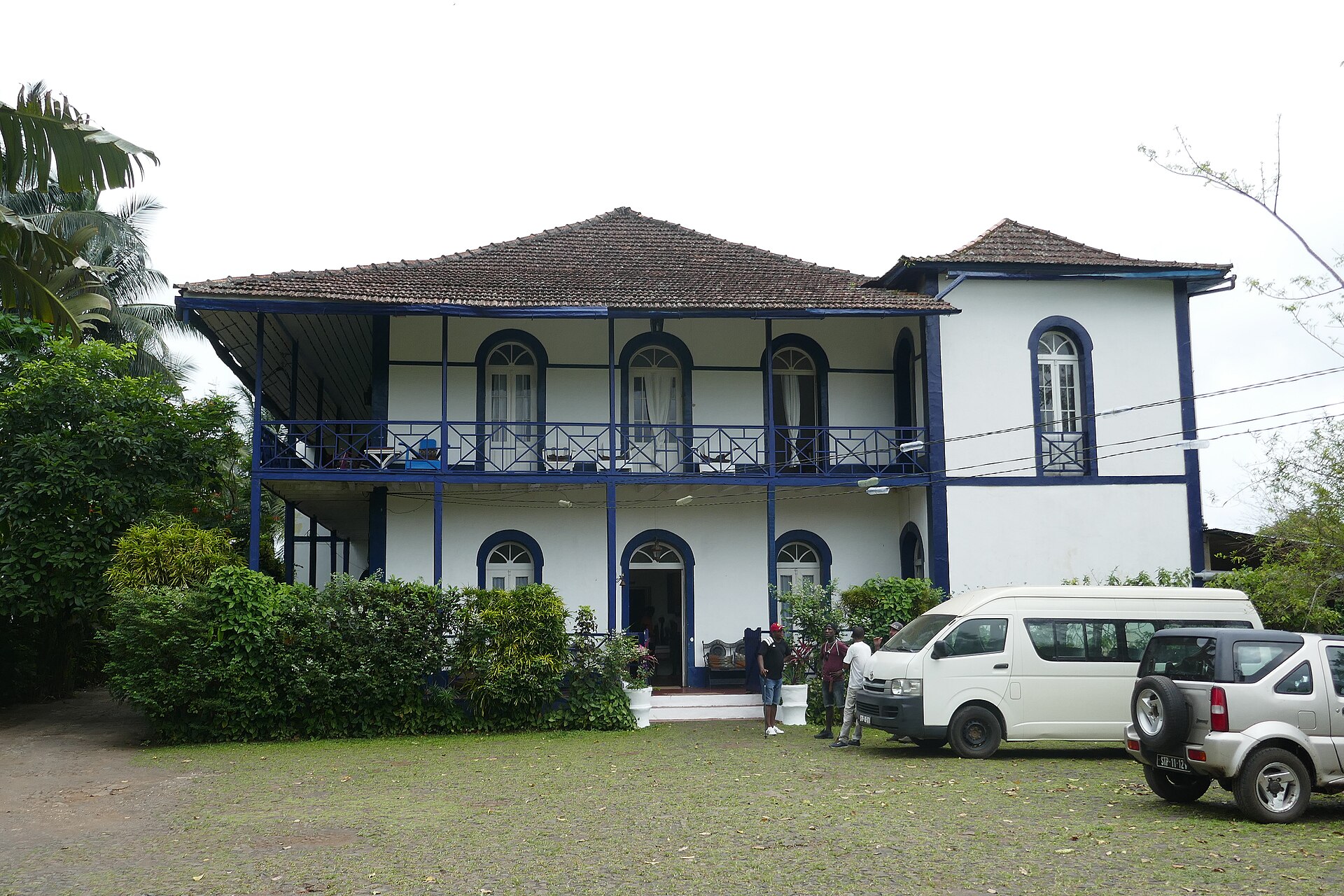
UNESCO describes the property in these words: “The serial property comprises six geographically separate roças (Portuguese colonial agricultural plantations) located on the islands of Sao Tome and Principe: Monte Café, Agua Izé, Diogo Vaz, Sao Joao, Sundy, and Belo Monte. Together, they represent a planned colonial plantation system dedicated primarily to coffee and cocoa production, combining agricultural land, industrial infrastructure, residential areas, and social facilities within highly structured spatial layouts. The property illustrates the operation of a large-scale colonial agro-industrial system, based on forced migration and labour, from the late 19th century through the mid-20th century, to sustain global commodity production after the abolition of slavery.”[1]
Background
This card draws on an article about cocoa in São Tomé and Príncipe, not on one about the roças themselves. It says cocoa was introduced in 1819, when the islands were a Portuguese colony, and the first tree to grow fully was on Príncipe in 1824.[2] From 1905 to 1911 the islands exported more cocoa than anywhere else in the world and were nicknamed the Chocolate Islands. The article says British journalists' revelations of poor labour conditions led to European boycotts of São Toméan cocoa.[2]
The plantations, as reported in 2019 and 2026
France 24 reported in 2019 that, before World War I, the archipelago was the world's leading cocoa exporter and had 30 cocoa and coffee estates, called roças, with electricity, medical care and a railway, run as what it called a well-oiled feudal system. At their height they housed 20,000 people in villages and 33,000 on the roças.[3]
Workers came from Angola, Mozambique, Gabon and Congo. After 1876 enslaved workers became "contract" employees, often brought by force from the mainland colonies. After independence in 1975 the socialist government nationalised the roças and production failed. About 1,300 people still lived on Roça Agostinho Neto, some of them in its abandoned hospital.[3]
Africanews reported on 28 July 2026 that six plantations, Monte Café, Água Izé, Diogo Vaz, São João, Sundy and Belo Monte, had been added to the World Heritage List at the Committee meeting in Busan. It says the estates preserve the memory of thousands of workers who were brought to the islands under harsh conditions.[4]
- The roças as buildings and as a labour system: their layout, the contract workers (serviçais), and what remains today. The article read here covers only the cocoa trade.
- São Toméan voices, including descendants of plantation workers.
- Local voices: none yet.
- The 2019 figures are from one report on one plantation and have not been checked against a census. Descendants' and former workers' own accounts of the roças are not in either report.
Sources
- Institutional[1] The Roças of Sao Tome and Principe: Colonial Agricultural System and Forced Migration. UNESCO World Heritage Centre, World Heritage List (open data, CC BY-SA 4.0). whc.unesco.org retrieved 7 Oct 2026
Read from UNESCO's open-data record (data.unesco.org, dataset whc001); the web page itself could not be opened from this project's tools. Texts are UNESCO's own. - Encyclopedia · to verify[2] Cocoa production in São Tomé and Príncipe. Wikipedia. en.wikipedia.org retrieved 7 Oct 2026
Used for background that the UNESCO record does not give. Each statement is limited to the article's lead and opening sections; confirm against specialist sources. - Press[3] Ravages of time on an African cocoa plantation. France 24, 31 May 2019. www.france24.com retrieved 7 Oct 2026
About one plantation, Roça Agostinho Neto, in May 2019. - Press[4] São Tomé and Príncipe's historic plantations added to UNESCO world heritage list. Africanews, 28 Jul 2026. www.africanews.com retrieved 7 Oct 2026
A short agency report; no one is quoted.