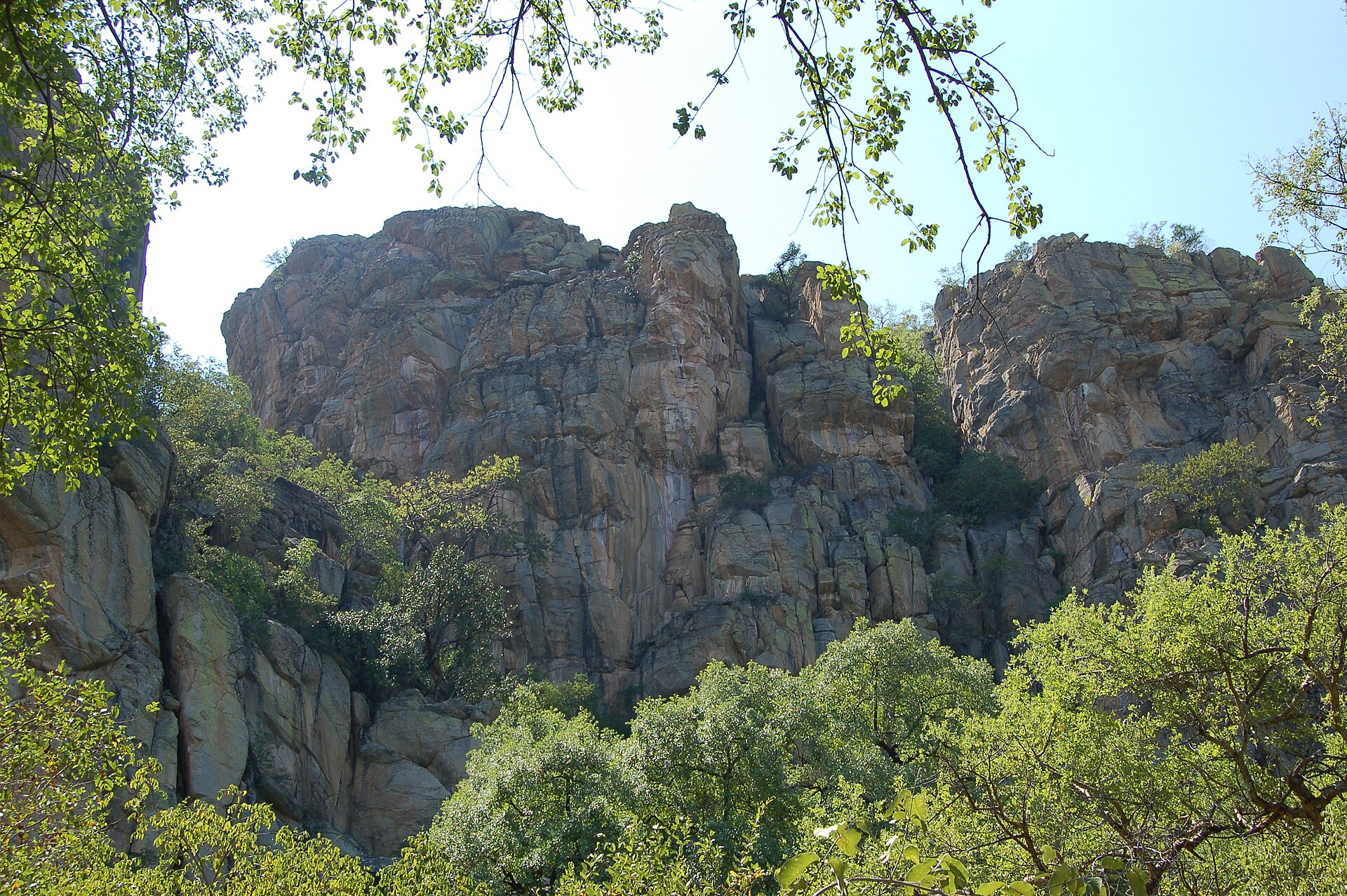
What UNESCO says
UNESCO describes the property in these words: “With one of the highest concentrations of rock art in the world, Tsodilo has been called the "Louvre of the Desert". Over 4,500 paintings are preserved in an area of only 10 km2 of the Kalahari Desert. The archaeological record of the area gives a chronological account of human activities and environmental changes over at least 100,000 years. Local communities in this hostile environment respect Tsodilo as a place of worship frequented by ancestral spirits.”[1]
Background
The Tsodilo Hills are rock art, rock shelters and caves in Botswana. Wikipedia says UNESCO listed them in 2001 for their religious and spiritual significance to local peoples and their record of human settlement over many millennia, and that over 4,500 rock paintings are estimated there.[2] There are four chief hills, known as Male, Female and Child plus an unnamed knoll. The highest is 1,400 metres above sea level and they stand about 40 km from Shakawe.[2] The article adds that the most famous of the San paintings, the Laurens van der Post panel, is named after the writer who first described them in his 1958 book The Lost World of the Kalahari.[2]
The paintings, as the British Museum's archive describes them
The British Museum's archive says Tsodilo has around 400 rock art sites with more than 4,000 individual paintings and has been called "the Louvre of the Desert". It has four main hills, Male, Female, Child and North, and shows human occupation going back 100,000 years.[3]
Unlike much San rock art, which is brush-painted in fine lines, the Tsodilo paintings are finger-painted. It counts 160 depictions of cattle shown in the same style as wild animals, and more geometric designs than anywhere else.[3]
At sunset the western cliffs glow so that the local Juc'hoansi call them the "Copper Bracelet of the Evening", and the archive says that for the residents the hills are a sacred place inhabited by the spirits of the ancestors.[3]
- The communities, including the Hambukushu and the San, for whom the hills are sacred: their own accounts are not in the article read here.
- Archaeology: the settlement record the article calls 'unique' is not described in the part read here.
- Local voices: none yet.
- That is the museum's account; residents' and the Juc'hoansi's own accounts of the hills are only mentioned there, not given.
Sources
- Institutional[1] Tsodilo. UNESCO World Heritage Centre, World Heritage List (open data, CC BY-SA 4.0). whc.unesco.org retrieved 7 Oct 2026
Read from UNESCO's open-data record (data.unesco.org, dataset whc001); the web page itself could not be opened from this project's tools. Texts are UNESCO's own. - Encyclopedia · to verify[2] Tsodilo. Wikipedia. en.wikipedia.org retrieved 7 Oct 2026
Used for background that the UNESCO record does not give. Each statement is limited to the article's lead and opening sections; confirm against specialist sources. - Institutional[3] Tsodilo, Botswana. The British Museum, African Rock Art (with the Trust for African Rock Art). africanrockart.britishmuseum.org retrieved 7 Oct 2026
The site's security certificate did not verify from the tools used; the text was read with verification switched off.