🇸🇮 Ljubljana · Lubiana
Southern Europe
- 10ka, klub smeha
- Arhiv
- Bangladeš
- Aladin Hostel (Dorm €15)
- Celica (Dorm €20)
- Hostel Tabor (B&B double €54)
- Fluxus Hostel (Dorm €21 ppn)
- Most Hostel (Dorm €21 ppn, double €60)
Getting there and away: By bus: Arriva Bus takes 50 min to the main bus and railway station ("Ljubljana AP", Stand 28), with several stops. It runs every 30 min M-F 05:20-20:10, and Sa Su holidays 06:10–19:10. The fare is €4.10, pay the driver on boarding; cannot pay with the city Urbana card.
Elected Green Capital of Europe, Ljubljana boasts a fully pedestrianized historic center and excellent security control. It represents the ideal model of a small sustainable and safe capital.
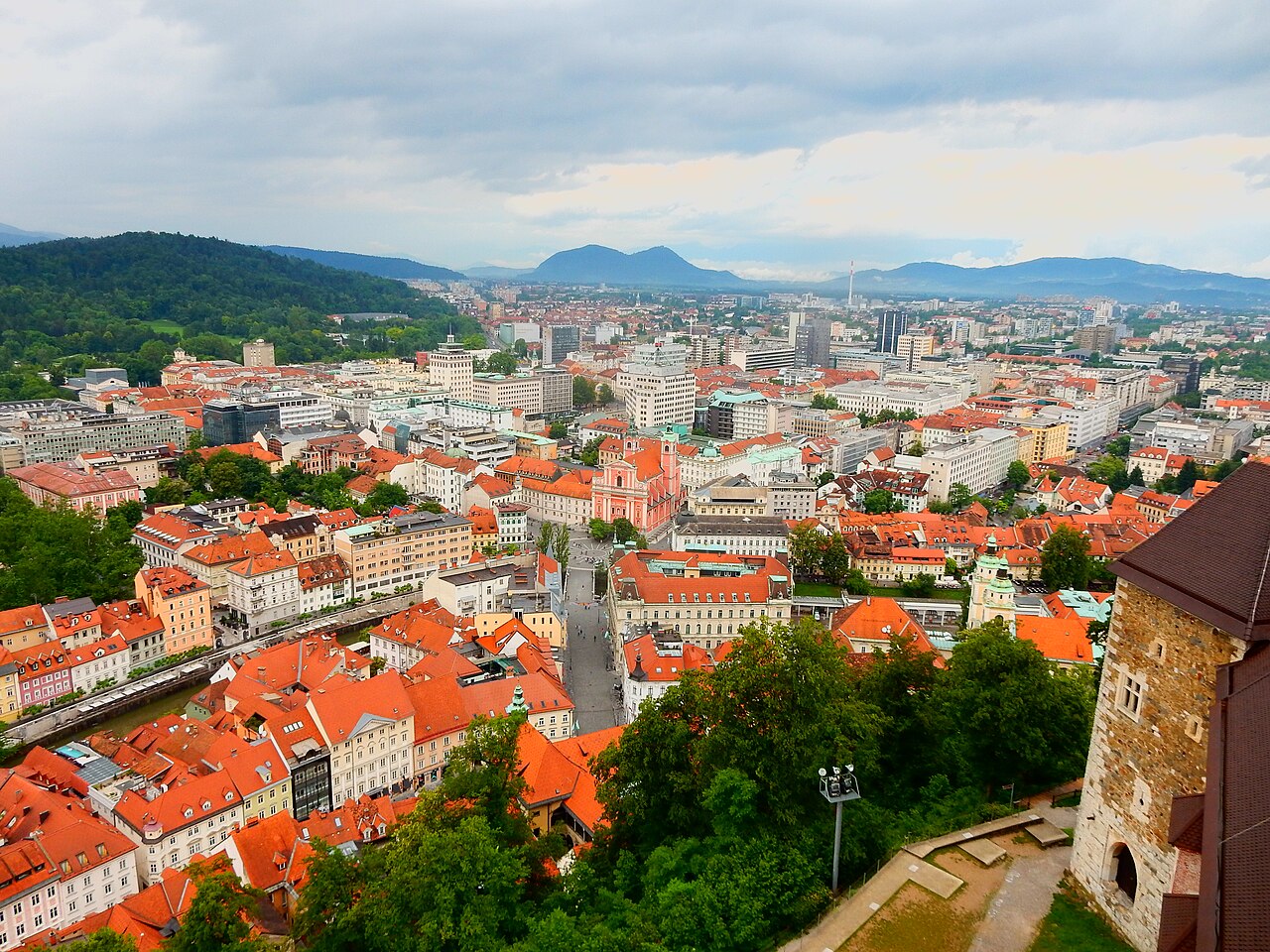
Ljubljana ("lee-oo-blee-AH-nuh") is the small but delightful capital of Slovenia. While the city's population had grown to 295,500 in 2020, the sights and amenities are concentrated in the charming old centre. It's full of artists, museums, and galleries, it's friendly and easy to reach, and it's a good base for exploring the rest of the country. Ljubljana stands at the entrance to a plain in an otherwise mountainous region, the confluence of several river valleys, so it's been a focus for settlement, trade and transport since prehistory. The first known city was the Roman Colonia Iulia Aemona; in medieval times it became Laibach and this name is still used by some German-speakers (as well as modern Slovenia's most notable cultural export, the band of that name). It fell under the gravity of Austria-Hungary and was a duchy or province of the Habsburg Empire until 1918. For much of the 20th century it was part of Yugoslavia until independence in 1991. This means that Ljubljana has simply been a regional capital, and has only been the national capital of a relatively small country for a few decades. The city landscape reflects this: it's compact and walkable, cosy and friendly, rather than grandiose. There are no vast ceremonial boulevards, bling palaces or imperial fists of fortification. It's not a place where you hop around ticking off must-see sights, like a bug with a selfie-stick for antennae. Relax, stroll and enjoy the atmosphere. No-one really knows how its current name came about: it resembles ljubljena - "beloved" - in Slovenian, but that seems to be just a happy coincidence. It sits in the valley of the Ljubljanica river, with green hills hemming it in on either side. The river makes a right angle, with the castle and oldest parts of the city on the hill in the southeast quadrant. A 19th century street grid extends north of the river, then the modern town sprawls to the west and north. Three natural disasters shaped the city architecture. An earthquake of 1511 caused extensive re-building in Renaissance style, and in stone to curb the fires of the wooden city. Another earthquake in 1895 prompted rebuilding in Vienna Secession style. It was flooded by the river multiple times until the Gruber Canal was cut across the southeast quadrant in the 18th century, turning the castle hill into an island. Therefore the main flow bypasses the old centre, which was protected from the devastating 2010 floods of the Danube catchment region. The "Triple" and "Dragon" bridges stand intact as proud symbols of Ljubljana. Ljubljana is a year-round destination but you need to dress for the Balkan climate. Summers are warm, with daytime highs of 30°C. There are often public events and festivals, with streets converted from traffic thoroughfares to event spaces, but afternoons can be humid with thunderstorms and downpours.
Structured data source (DTD-validated XML — city_report.dtd):
Canonical URI (element <source_url>, also used as itemid microdata):