🇦🇹 Vienna
Western Europe
- Innere Stadt: Quartiere di Vienna.
- Landstraße: Quartiere di Vienna.
- Wieden: Quartiere di Vienna.
- Margareten: Quartiere di Vienna.
- Mariahilf: Quartiere di Vienna.
- 's Beisl am Eck
- 's Stammbeisl
- 6er Haus
- Anton Frank - cafe bar
- BackBone Irish Pub
- Bockshorn Irish Pub
- Brendl
- Bricks
Vienna International Airport Vienna International Airport Vienna International Airport url email address lat48.110278 long16.569722 directionsjust outside the city limits of Vienna on the far side of the City of Schwechat phone tollfree hours price wikipediaVienna International Airport image2011-06-14 10-23-53 Austria Niederösterreich Fischamend Markt.jpg wikidataQ32999 lastedit2025-07-26 contentTo get to Vienna, you have three different railway options. The cheaper but slower S-Bahn line S7 (24 minutes; €4.60) and the more expensive but faster City Airport Train (15 minutes; from €11) both go to Wien-Mitte/Landstraße.
Consistently ranked the world's most livable city, Vienna excels in social housing and public transport. Its balance between imperial culture and sustainable modernity is its distinctive signature.
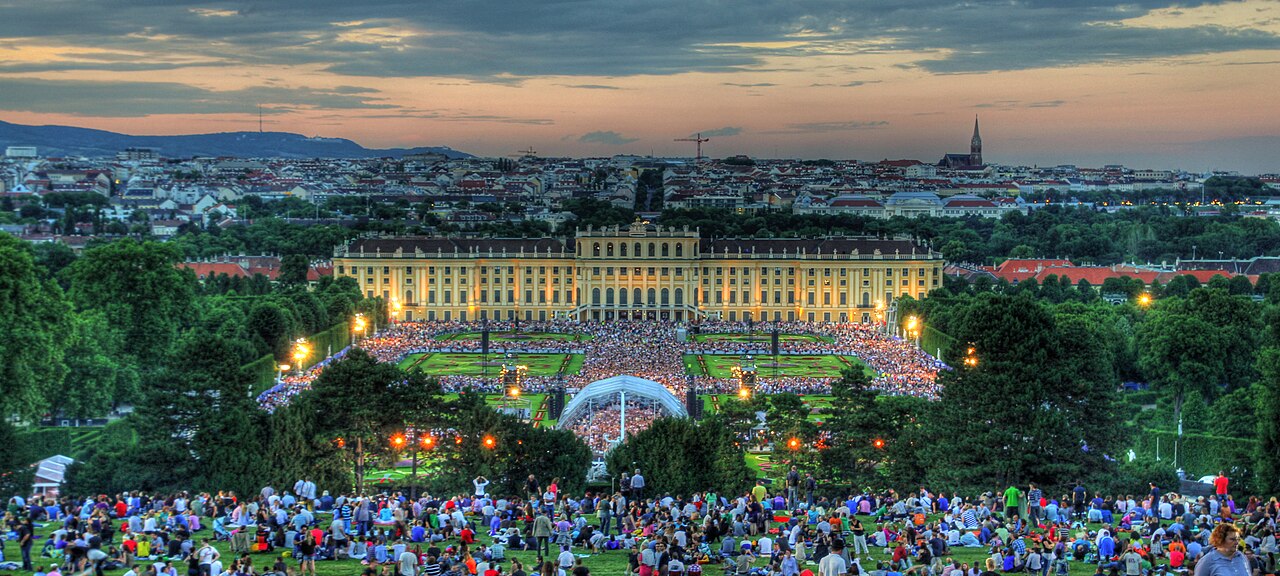
Vienna (German: Wien; Austro-Bavarian: Wean) is the capital of Austria and by far its most populous city, with an urban population of 2 million and a metropolitan population of 2.9 million (2023). It is the country's artistic, cultural, economic and political centre. It is known for its high living standards, relaxed yet elegant lifestyle and rich musical life. Vienna, renowned as the former seat of the Habsburg court and its diverse empires, stands not only as a grand metropolis but also as a historical center that has perpetually thrived with a substantial population. This city's distinction lies in its privileged stature, fostering an environment that has nurtured numerous eminent artists, notably Beethoven, Haydn, Liszt, Mozart, Schubert, and Johann Strauss II, among others. It was long the largest German-speaking city in the world before being surpassed by Berlin. The large historic city centre of Vienna filled with monuments to its imperial past is inscribed on the UNESCO World Heritage List. Vienna is broadly divided in inner (1–9) and outer districts (10–23). The 23 districts or wards each have a name and a number. They vary immensely in size and each has its own flair. These function subordinately to the city as decentralized administrative branches of the commune, and make local decisions. Wikivoyage has divided the 23 official districts of Vienna into 13 here for travel purposes. The low-lying Danube plain in and around what is now Vienna has had a human population since at least the late Paleolithic (see Prehistoric Europe); one of the city's most famous artifacts, the 24,000-year-old Venus of Willendorf, now in Vienna's Natural History Museum, was found nearby. Vienna's own recorded history began with the Romans, who founded it in the 1st century CE as Vindobona, one of a line of Roman defensive outposts against Germanic tribes. Vindobona's central garrison was on the site of what is now the Hoher Markt (the "High Market" so-called because of its relative height over the Danube), and you can still see astounding excavations of its foundations there today. Given its prestige, Vienna hosted the Habsburg court for several centuries, first as the Imperial seat of the Holy Roman Empire, then the capital of the Austrian Empire, and later of the Austro-Hungarian Empire, which finally fell in 1918 with the abdication of the last Emperor Karl I. The court tremendously influenced the culture that exists here even today: Vienna's residents are often overly formal, with small doses of courtliness, polite forms of address, and formal dress attire.
Structured data source (DTD-validated XML — city_report.dtd):
Canonical URI (element <source_url>, also used as itemid microdata):