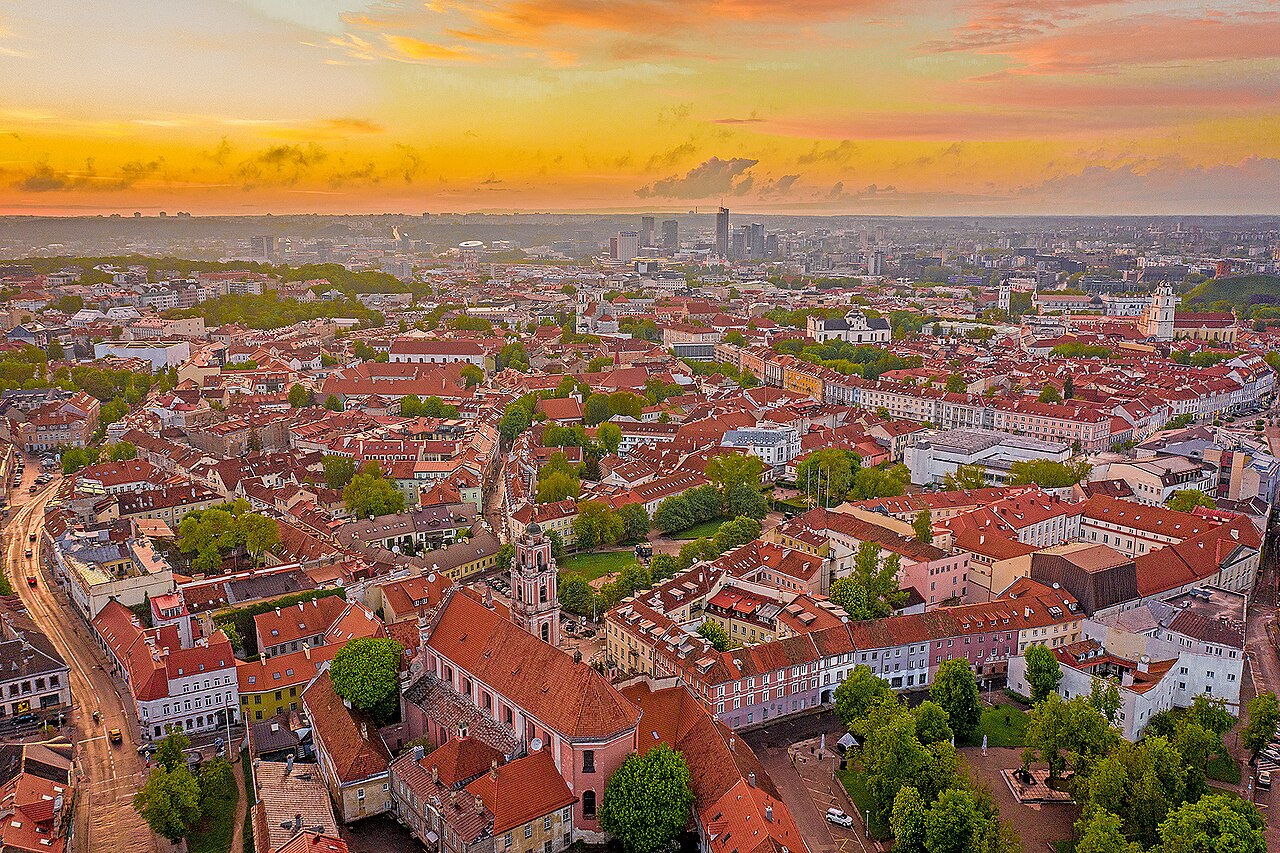
🇱🇹 Vilnius
Northern Europe
- Akivarai
- Akvariumas
- Alaus biblioteka
- Alaus namai
- Alaus studija
- Amatininkai
- Apuokas
- Filaretai Hostel (Dorm €33 ppn)
- Jimmy Jumps House (Dorm beds from ~€18, privates from ~€40)
- Pogo Hostel (Dorm €20 ppn)
- City Hotel Algirdas (B&B double €50)
- Domus Maria (B&B double €60)
Buses leave from outside Arrivals every 15-30 min and take 15 min to go downtown. Simplest is to buy a €1 single ticket by card, and you might pay extra for bulky luggage. "Get around" below describes other ticket deals, such as the smart card Vilniečio kortelė — buy it from the Narvesen kiosk next to Arrivals.
Green and welcoming capital, Vilnius stands out for a baroque historic center and a startup incentive policy. It offers a high quality of life at decidedly low costs.
Vilnius is the capital and largest city of Lithuania. It has a beautiful baroque Old Town, listed as a , and excellent tourist facilities in all price ranges. It stands on the River Neris in the southeast pocket of the country, the Dzūkija region, and in 2023 had a population of 629,000. Vilnius has been central to the country's life for as long as there has been Lithuania, but that has often been a tragic tale. Its Neolithic people traded in Baltic amber. In the early Middle Ages five petty kingdoms combined into two then one, when Mindaugas in 1253 became Lithuania's first king and noble Christian convert. The country splintered after his assassination but was re-united under Gediminas, who established Vilnius castle — in legend on the site where a wolf in a dream told him to build. But the real wolves were his neighbouring countries, and finding a powerful ally meant adopting their religion. Poland was the best bet and a dynastic marriage in 1486 united the crowns, later the nations, and Lithuania became Roman Catholic. Vilnius Old Town was largely built in the following 150 years. This united Polish–Lithuanian Commonwealth grew almost to the Black Sea, but all the power and money shifted to Poland. Like Hungary in the Austro-Hungarian Empire or Ireland within Britain, Lithuania was the poor country cousin. And then Poland fell, with its territory carved up between Prussia, Austria and Russia, and others snatching what they could. Lithuania became a territory of the Russian Empire. Poland and Lithuania only regained independence after the First World War, and almost at once were at war with each other and with Russia. Vilnius was captured and from 1920 was a Polish exclave, and the Lithuanian capital moved to Kaunas. In the run-up to the Second World War Russia (as the Soviet Union) again seized the territory. This history meant that when Nazi Germany invaded in 1941, they found many local supporters, and the Jewish population of Vilnius was slaughtered. Postwar the Soviet iron fist clutched Lithuania, until 1991 when civil unrest and the collapse of the USSR enabled the country to seize independence. It looked west for allies, adopting capitalism, joining NATO and the European Union, and — crucially for travellers — welcoming the budget airlines. All this has made Vilnius a friendly, tourist-oriented city, with a wealth of sights reflecting its layers of history. Tourist information: Go Vilnius have a kiosk at the airport and another in Cathedral Square, both open daily 10:00-19:00.
Structured data source (DTD-validated XML — city_report.dtd):
Canonical URI (element <source_url>, also used as itemid microdata):