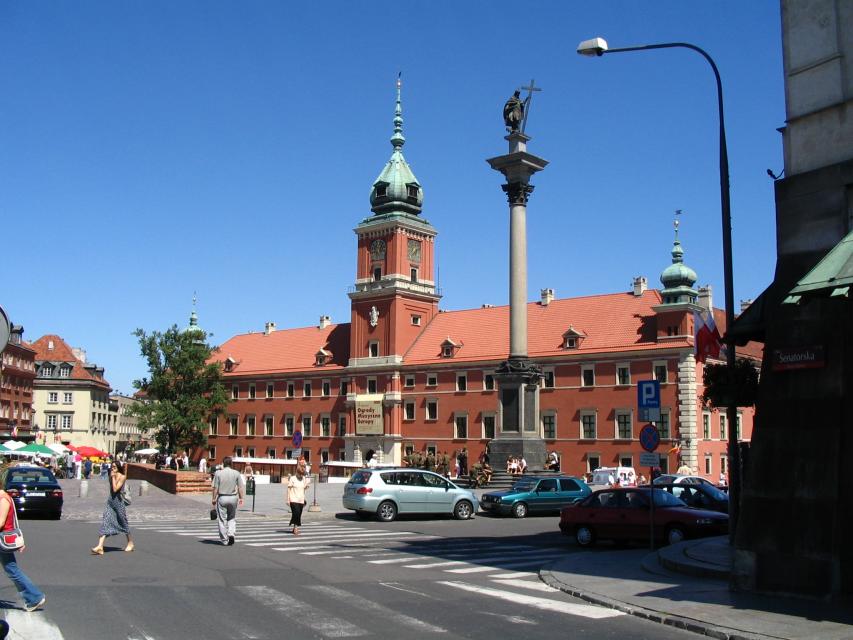
🇵🇱 Warsaw · Varsavia
Eastern Europe
- Old and New Town: Quartiere di Varsavia.
- Śródmieście: Quartiere di Varsavia.
- Western Centre: Quartiere di Varsavia.
- Praga: Quartiere di Varsavia.
- South: Quartiere di Varsavia.
- Amarant
- Bar pod Kufelkiem
- Bez Słowa
- Cafe Foksal
- Cafe Rock'n'Roll
Regular Warsaw transport tickets issued by ZTM (the local transport operator which runs city buses, trams and the metro) are valid on SKM train services between the airport and Warsaw. The airport is in fare zone 1 so a single adult ride is 3.40 zł. If you need a bus at the other end, get a one-transfer ticket (valid 75 min) for 4.40 zł.
An extraordinary example of reconstruction and resilience, Warsaw is now a vertical and dynamic metropolis. It combines a growing financial sector with large green spaces and improved urban safety.
Warsaw (Polish: Warszawa) is Poland's capital and largest city. Warsaw is a bustling metropolis and one of the European Union's fastest-developing capitals and the Union's ninth most populous urban centre. It has a mixture of new and old in its eclectic architectural mix, and is constantly changing. There is a large variety of museums, galleries and other tourist attractions, and there is always something happening throughout the year. While sprawling, it is quite easy to navigate for tourists thanks to a good public transit system, and most important sights are quite close to each other. There is no shortage of accommodation options and a wide choice of restaurants and bars. Warsaw's nightlife is also on the rebound, and a reborn cafe culture has taken over the city. A city of 1.8 million inhabitants (2021), it sits on the Vistula River (Polish: Wisła) in the middle of the country. Warsaw's history of rapid development after many wars that ravaged and destroyed the city has earned it a reputation as a "phoenix city", able to recreate itself from the ruins and regain its erstwhile glory every time. During the Second World War, it suffered a fate similar to Rotterdam and Dresden in that it was almost completely razed, although in the case of Warsaw it was a much more tragic story of successive destruction and defeat. Due to the great efforts of its surviving inhabitants and, indeed the entire nation, it was rebuilt from a field of rubble, with its historic core recreated, but much of its heritage was lost. Warsaw also had one of the largest Jewish populations in Europe, which for the most part perished during the war, making Warsaw an important place of Holocaust remembrance. There are records of human settlements and economic activity in the area of what is now Warsaw from the 9th century onwards, but it wasn't until the 13th century that Warsaw was founded by the Dukes of Mazovia. While developing as an administrative and economic centre, it played second fiddle to Płock within Mazovia until the 15th century, and was by no means a match for Poland's former capital, Kraków. It gained growing importance due to its economic might and strategically important central location in Poland, cemented when the Polish Sejm (parliament of nobles) relocated there permanently in the 16th century, and it became the site of royal elections. In 1596, it became the de facto capital of the country when King Sigismund III Vasa decided to permanently relocate to what is now the Royal Castle in Warsaw. The city started to develop rapidly beyond the what is now the Old and New Town, as noblemen started moving in and building mansions and palaces around town.
Structured data source (DTD-validated XML — city_report.dtd):
Canonical URI (element <source_url>, also used as itemid microdata):