Eastern Africa
Eritrea
Capital Asmara · 3.6 million people
Population3.6 million
Area121,766 km²
People per km²30
Rank by population40 of 54
Eritrea at a glance
Eritrea is in Eastern Africa. Its capital is Asmara[1]. About 3.6 million people live there[3], on 121,766 km²[4]: number 40 by population and number 36 by area of the 54 countries on this site. The sentences and figures on this page are calculated from those sources; the writing about places and people is on the cards and stories below.
- Capital
- Asmara[1]
- Region
- Eastern Africa[2]
- Population
- 3,607,003, 2025 estimate[3]
- Area
- 121,766 km², including inland water[4]
- Government
- authoritarian[5]
- Languages marked official by the Factbook
- Tigrinya, Arabic, English[5]
- African languages mentioned by the Factbook
- Tigre, Kunama, Afar[5]
- Religion
- Eritrean Orthodox, Roman Catholic, Evangelical Lutheran, Sunni Muslim[5]
Places in Eritrea
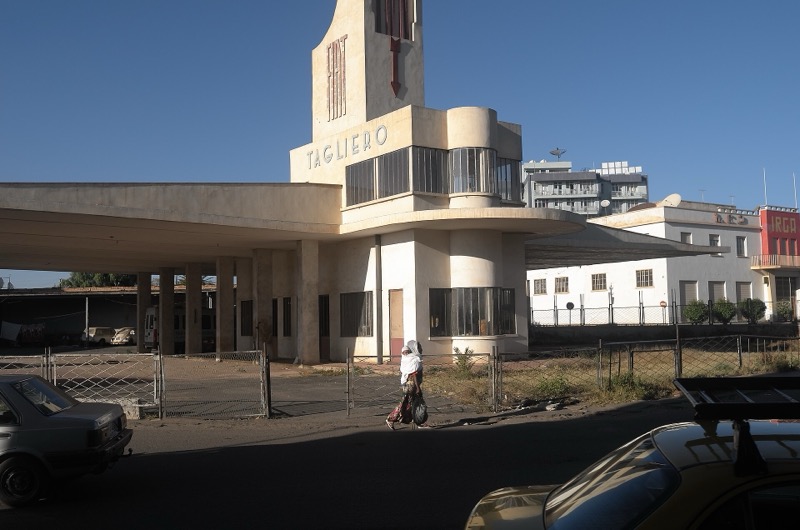
Stories that touch Eritrea
- History · 2 min readAksum: the great power you were never taughtSeventeen centuries ago a kingdom in the Horn of Africa minted its own coins, wrote in its own script and sat on the trade route between Rome and India.Eritrea · Ethiopia
- Food · 2 min readInjera: the bread that is also the plateA sour, spongy flatbread made from a grain that began in Ethiopia, and the centre of the meal in Ethiopia and Eritrea.Ethiopia · Eritrea
- Myths · 1 min readWas Africa's history only ever spoken?The oral tradition is real and rich. But writing has a long history on the continent too, from the Ge'ez script of Aksum to the manuscripts of Timbuktu.Ethiopia · Eritrea · Mali
Keep exploring
- Eritrea in the table of all 54 countries, to compare its figures.
- Society: faith, government and languages side by side.
- The quiz, with questions on countries, history and food.
What readers add
No local voice on Eritrea yet.Notes are added once the author has agreed to publication, and are read by people who know the subject afterwards.
- Population is an estimate for 2025 and area a 2023 value; neither is a census figure.
- Government, languages and religions are the World Factbook's words and carry its own estimate years. Language and religion groupings are ours and flatten real differences.
- This page has no history, daily life or economy of its own yet. Those belong to the place cards and stories, with their own sources and local voices.
Sources
- Institutional[1] Country metadata: capital city. World Bank. api.worldbank.org retrieved 6 Oct 2026
One capital per country. The World Bank writes some names without accents; they are restored here. - Institutional[2] Standard country or area codes for statistical use (M49). United Nations Statistics Division. unstats.un.org retrieved 6 Oct 2026
Source of the five African subregions. The classification is for statistical convenience and implies no assumption about political affiliation. - Institutional[3] Population, total (SP.POP.TOTL). World Bank. data.worldbank.org retrieved 6 Oct 2026
Most recent value per country, 2025, obtained through the World Bank API. Estimates, not census counts. - Institutional[4] Surface area, sq. km (AG.SRF.TOTL.K2). World Bank. data.worldbank.org retrieved 6 Oct 2026
Most recent value per country, 2023, obtained through the World Bank API. Total area including inland water. - Institutional · to verify[5] The World Factbook: Government type, Languages, Religions (africa/*.json). CIA, via the factbook/factbook.json copy on GitHub. github.com retrieved 7 Oct 2026
Public-domain text copied unchanged. The copy does not say which edition it holds, and each figure carries its own estimate year in the text. Shares are estimates from censuses or surveys of different years; official languages are as the Factbook records them. - Institutional[6] African Union member states. African Union. au.int retrieved 7 Oct 2026
Lists 55 member states by region, including the Sahrawi Republic. The list does not show suspensions. - Institutional[7] African Union overview. African Union. au.int retrieved 7 Oct 2026
Gives the founding of the OAU (May 1963) and the launch of the African Union (July 2002). - Institutional[8] COMESA member states. COMESA. www.comesa.int retrieved 7 Oct 2026
The table lists 21 states. Read on 2026-10-07. - Institutional[9] COMESA in brief. COMESA. www.comesa.int retrieved 7 Oct 2026
Says COMESA began as the Preferential Trade Area (1981) and became COMESA in 1994. - Institutional[10] About IGAD. Intergovernmental Authority on Development. igad.int retrieved 7 Oct 2026
Gives the eight member states, IGADD (1986) and the relaunch as IGAD (November 1996). - Institutional[11] Statement on the return of Sudan to IGAD. Intergovernmental Authority on Development. igad.int retrieved 7 Oct 2026
Dated 9 February 2026. IGAD welcomes Sudan resuming full participation; the statement does not say when or why Sudan stepped back.