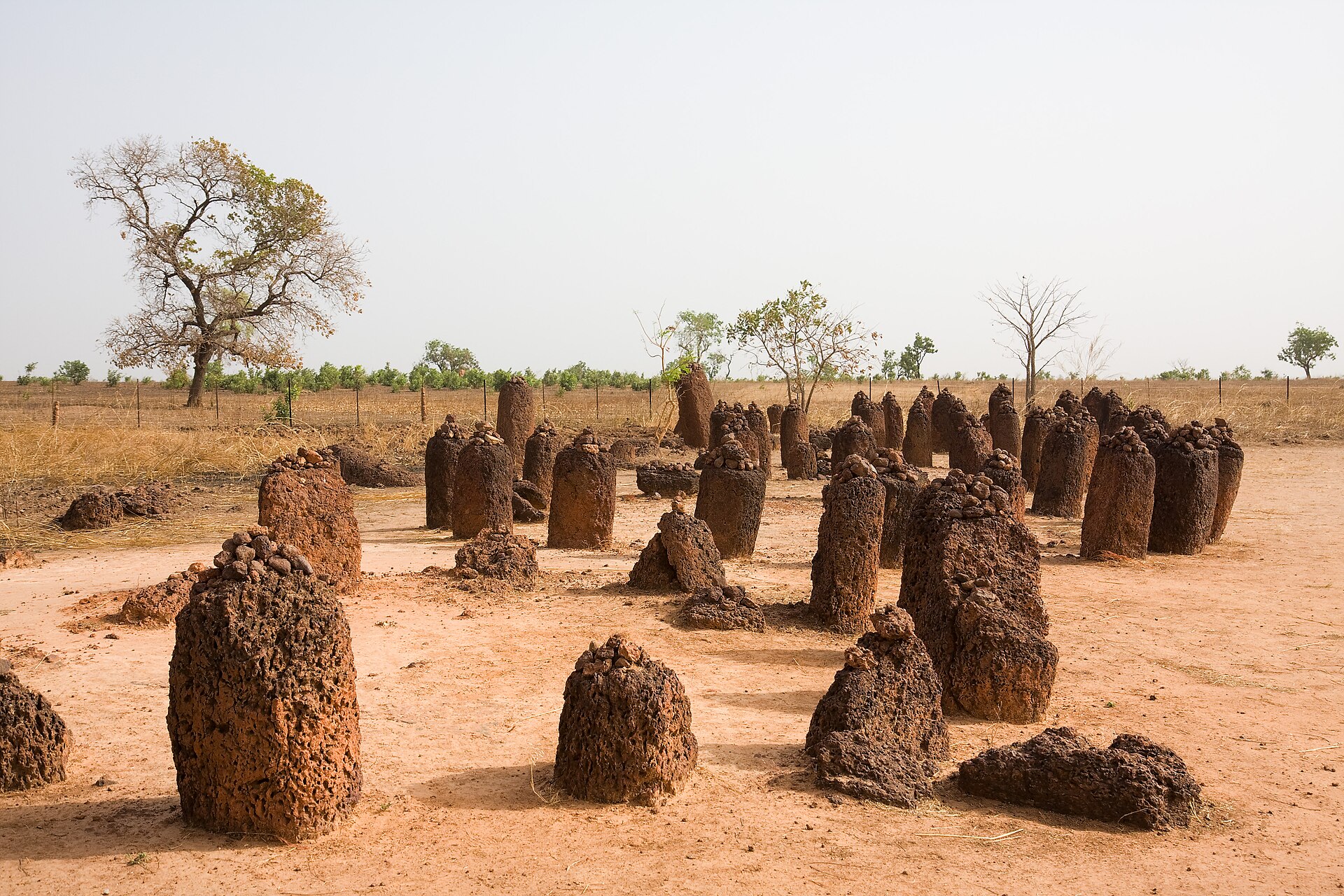
What it is
Wassu is one of four groups of stone circles that UNESCO lists together as the Stone Circles of Senegambia. The other Gambian group is Kerbatch. Wanar and Sine Ngayène are in Senegal.[1] Between them the four groups hold 93 circles. They belong to a wider concentration of more than 1,000 monuments in a band about 100 km wide along some 350 km of the River Gambia.[1]
- Inscribed
- 2006[1]
- Criteria
- i and iii[1]
- Whole property
- 4 groups, 93 circles, 2 countries[1]
- Circles at Wassu
- 11, with frontal stones[1]
- Burial finds at Wassu
- dated AD 927 to 1305[1]
- Managed by
- National Centre for Arts and Culture[1]
Wassu has 11 circles and their frontal stones, and UNESCO says it has the highest stones of the area.[1] Frontal stones are the ones that stand apart from a circle, usually to the east.[2] The pillars were cut from nearby laterite quarries with iron tools and shaped into almost identical cylinders or polygons, about two metres high on average and weighing up to seven tons. Each circle has between eight and fourteen stones, in a ring four to six metres across.[1]
Timeline
- 3rd c. BC to 16th c. ADThe span suggested by material excavated from some of the burial mounds across the four groups. UNESCO describes the whole landscape as created over more than 1,500 years. Researchers are not certain when each group was built.[1][2]
- AD 927–1305Burial finds at Wassu allow the monuments there to be dated to this span. It is not clear whether the mounds were built before or after the stone circles.[1][2]
- 1964–65The Anglo-Gambian stone circles expedition works at Wassu and at Ker Batch under the auspices of the Royal Anthropological Institute. The Institute's catalogue names F.A. Evans and P.O. Beale as its directors. UNESCO's text calls these the most recent excavations at Wassu and says the campaign was led by Evans and Ozanne. A report to the Prime Minister of The Gambia is printed in 1966.[3][1]
- 1967A laboratory run by Cheikh Anta Diop reports a carbon date for a sample from the Gambian circles. In a November letter Beale writes that it gave a date for the circle at Wassu. The catalogue does not give the date itself.[3]
- 1973–74A project for archaeological research in Senegambia is sponsored by the Royal Ontario Museum and the University of Waterloo.[3]
- 2006The Stone Circles of Senegambia are inscribed on the World Heritage List under criteria (i) and (iii), as a joint property of The Gambia and Senegal.[1]
- Oct 2015The deputy director general of the National Centre for Arts and Culture says it plans to restore heritage sites in the area and improve facilities for visitors, with private-sector help.[4]
Protection and visiting
UNESCO's statement says the National Centre for Arts and Culture manages Wassu and Kerbatch under a law of 1989, amended in 2003. Both sites are fenced. Four thatched round buildings, built in the manner of traditional houses, serve as a museum, a reception for visitors and lodging for the caretaker.[1] Local management committees support the work, and the funding comes mainly from government revenue, including visitor entrance fees, and other subventions.[1]
These lines describe the situation when the statement was written. See the gaps below for what is not known about the site today.
How old, and who built them
There is no consensus on who built the stone circles. No group today claims them as its ancestors' work in its surviving oral history, and the structures resemble burial practices of several living peoples.[2] Cheikh Anta Diop argued that the Serer built them, while Serer oral history credits earlier occupants of the area, whose identity is debated.[2]
Speaking to The Point in 2015, an official of the National Centre for Arts and Culture called the Wassu circles unique to The Gambia and to Africa. He said they are more than two thousand years old, that each stone weighs about 20 tonnes, and that they were raised as burial places for kings.[4]
These figures differ from UNESCO's, which give stones of up to seven tons and, for Wassu, burial finds dated between AD 927 and 1305. This card does not reconcile them. It reports both and marks the gap.
- The original excavation reports behind the dates. UNESCO gives the span AD 927 to 1305 for Wassu, and the 1967 carbon date is only mentioned in an archive catalogue, not given.
- Who led the 1964–65 expedition. The Royal Anthropological Institute catalogue names F.A. Evans and P.O. Beale. UNESCO's text names Evans and Ozanne. To be checked against the expedition report.
- The weight of the stones. A 2015 press report quotes about 20 tonnes each. UNESCO gives up to seven tons.
- The coordinates come from an encyclopedia article and have not been checked against UNESCO's map page, which was not part of the text supplied.
- The state of the site and its visitor facilities today. UNESCO's statement describes them as written for the inscription, and the newest press source is from 2015, updated in 2020.
- What the circles mean in daily life for people in the villages around Wassu. Only the local voices on this card can answer that.
Sources
- Institutional[1] Stone Circles of Senegambia. UNESCO World Heritage Centre. whc.unesco.org retrieved 6 Oct 2026
Text of the page supplied by the project owner, because automated access to unesco.org is blocked. One sentence places Wassu in “Guinea”, apparently a slip for The Gambia. The description text is published under CC BY-SA IGO 3.0. - Encyclopedia · to verify[2] Senegambian stone circles. Wikipedia. en.wikipedia.org retrieved 6 Oct 2026
Used here only for the term frontal stones, the debate over the builders and the coordinates. Confirm against excavation reports. - Institutional[3] Beale, Philip Ormrod “collection” (MS 465): The Gambia stone circles. Royal Anthropological Institute. therai.org.uk retrieved 6 Oct 2026
Archive catalogue of papers on the 1964-65 expedition. It lists reports and letters, including on carbon dating, but does not reproduce the dating result. - Press[4] Njie Baldeh, ‘Wassu Stone Circles are unique to Gambia’. The Point (Banjul), 13 Oct 2015. thepoint.gm retrieved 6 Oct 2026
Reports what an official of the National Centre for Arts and Culture said on a tour. Updated by the paper in August 2020.