🇸🇰 Bratislava
Eastern Europe
- Amajka
- Americke pub
- Bastion
- Bernard pri Lýceu
- Black Rose
- C2
- Chilli Pub
- Coral
- Patio Hostel (Prezzo N/D)
- Hostel Chors (Prezzo N/D)
- Wild Elephants Hostel (Prezzo N/D)
- Hotel Arcus (Prezzo N/D)
- Aston Business Hotel (Prezzo N/D)
There are no dedicated airport shuttles, however the airport is served as part of the municipal bus network. Use bus No 61 (or N61 at night) for a direct connection to the Central Train Station (Hlavná stanica). Or change for a tram at Trnavské mýto to get to the city (in order to get to the tram stop, use the underpass and the exit marked "Centrum" (city ) and take any tram in the direction towards .
Strategically located on the Danube, Bratislava combines competitive operating costs with rapid growth in the service sector. Its human scale allows for high safety standards and a swift transition to green infrastructure.
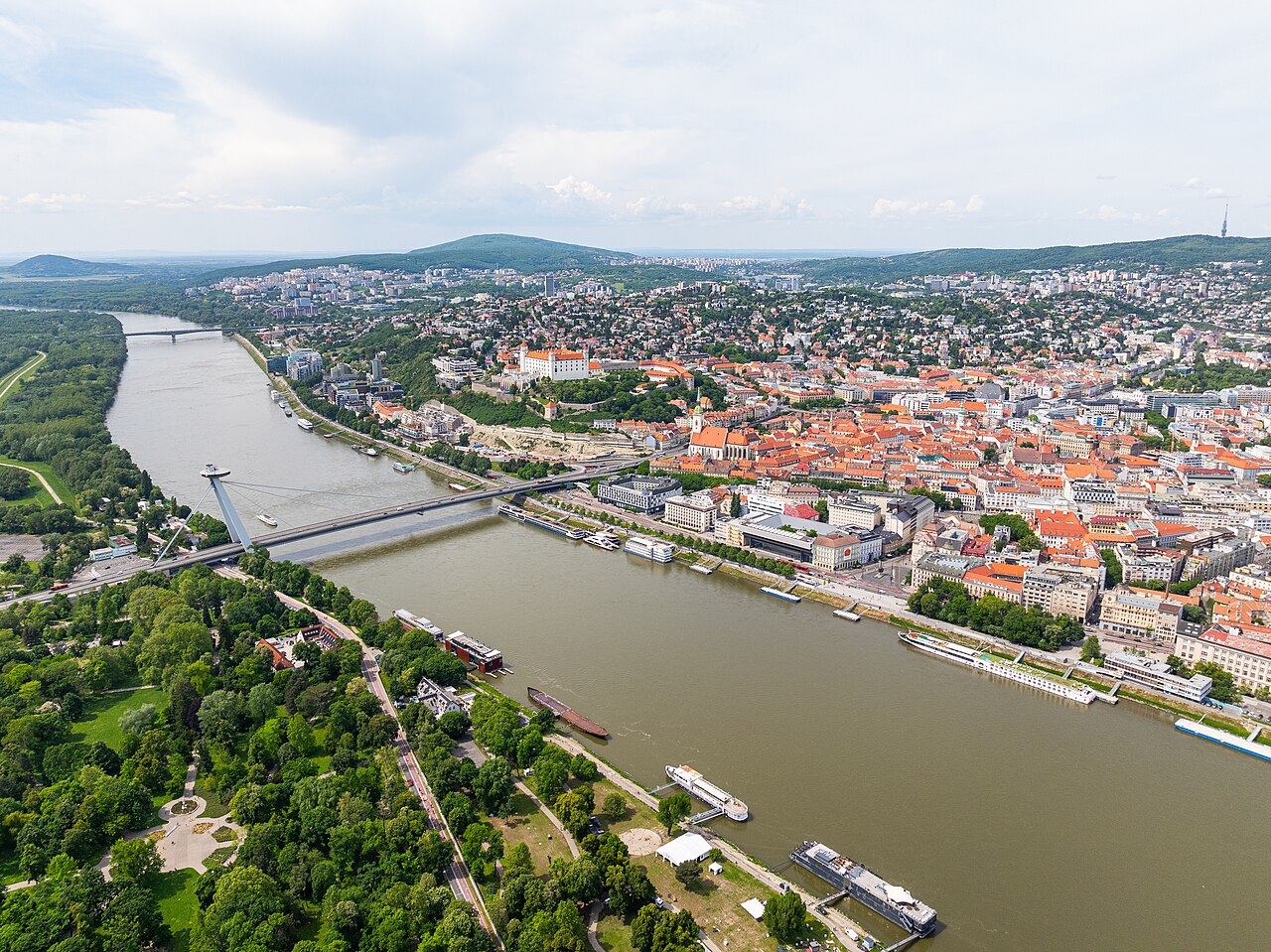
Bratislava (Hungarian: Pozsony, German: Pressburg, known as Prešporok before 1919), is the capital and largest city of Slovakia. It has a population of more than 475,000 (2021), and is the administrative, cultural and economic centre of the country. For most visitors, it is the entry point into the rest of the country. Located on the border tripoint of Slovakia, Austria and Hungary, the city has sat in the very hearts of empires since its earliest mention in the 10th century. As such, the city is a place of contrasts; the city centre features the medieval and renaissance old town, as well as the skyscraper-heavy business and shopping district; the outskirts feature both hillside villas, and communist-era apartment blocks. Bratislava has a very pleasant medieval inner city with narrow, winding streets, a hill-top castle next to the river Danube, and many historic churches and buildings to visit. The old town is centered on two squares, Hlavné námestie (main square) and Hviezdoslavovo námestie (Hviezdoslav square, named after a famous Slovak poet). Of a rather different architectural character are some of the communist-era buildings found in the modern parts of the city; a prime example is Petrzalka housing estate, the biggest Communist-era concrete block housing complex in Central Europe, which stretches on endlessly just across the river. Move further east and there are plenty of rural places to explore. There are farms, vineyards, agricultural land, and tiny villages less than 50 km to the north and east of Bratislava. Bratislava and its surroundings form the second-most prosperous region in Central and Eastern Europe, with a per capita GDP of around 167% of the EU-27 average. Bratislava is the sixth richest region of the European Union, and GDP per capita is about three times higher than in other Slovak regions. After the fall of the Great Moravian Empire, Slovakia became part of the Kingdom of Hungary from the 10th century (later included with the Austro-Hungarian Empire) until the end of the First World War. The city was the capital (1536-1784), the coronation city (1563-1830), and the seat of the Diet (1536-1848) of the Kingdom of Hungary for three centuries. In this period, eleven Hungarian kings and queens were crowned at St. Martin's Cathedral. At that time, the city was called Preßburg in German and Pozsony in Hungarian, and had a clear German (42%) and Hungarian (40%) ethnic majority (1910 census). In 1919, the Treaty of Trianon created Czechoslovakia, and Bratislava was attached to the newly founded state.
Structured data source (DTD-validated XML — city_report.dtd):
Canonical URI (element <source_url>, also used as itemid microdata):